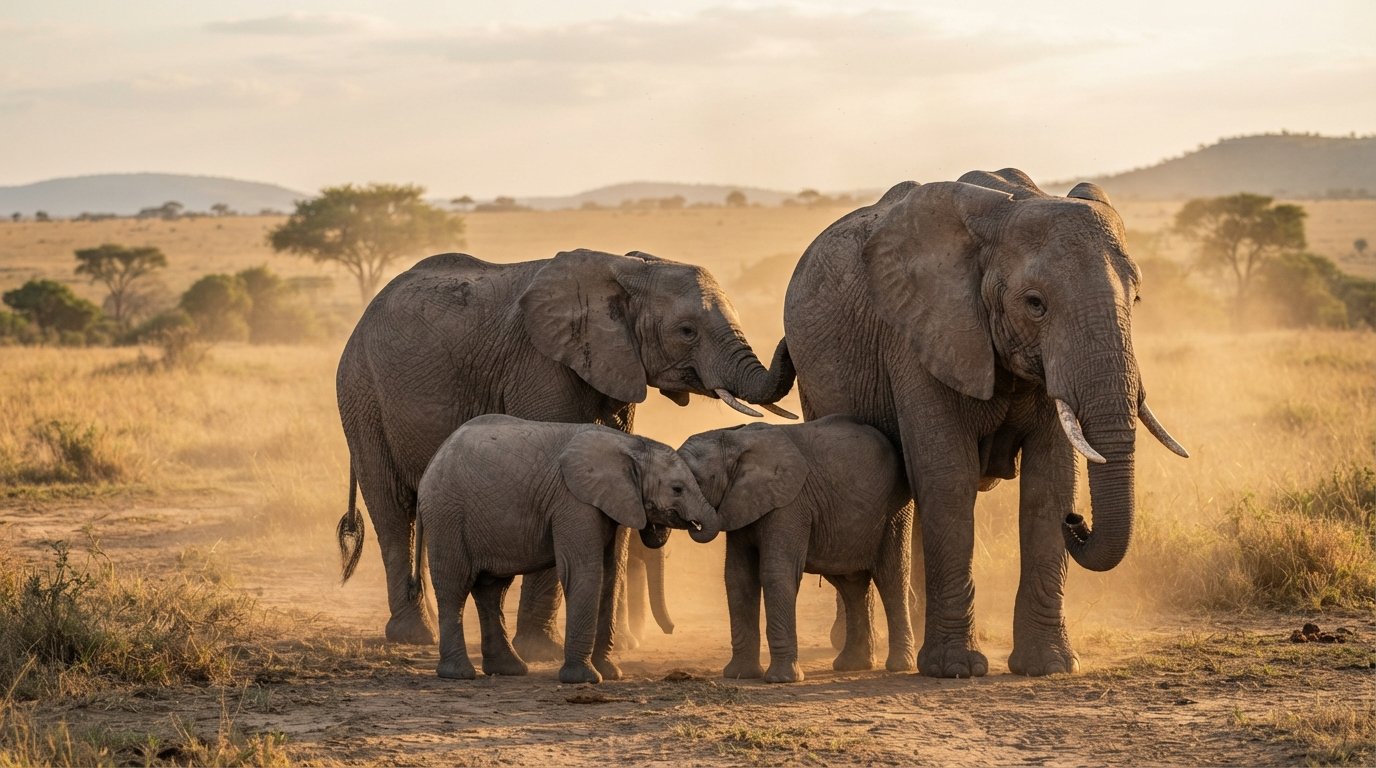
Across the African savanna, an elephant herd can look almost silent from a distance. A calf stays close to its mother. Two adult females move together through the grass. A distant member of the family disappears behind a line of trees. Yet the herd may be communicating all the time—through low rumbles, calls that travel farther than the human ear can detect, and subtle changes in sound that carry information across the landscape.
For years, researchers have known that elephants use a rich range of vocal signals. Their calls can help maintain contact, coordinate movement, and keep family groups connected. But a question remained: when an elephant calls, is it simply announcing itself—or can it direct a call toward one particular individual?
A landmark study published in Nature Ecology & Evolution in 2024 offered an extraordinary answer. Wild African elephants appeared to use individually specific, name-like calls to address particular members of their social groups. The sounds were not simply copies of the receiver’s own voice. Instead, the acoustic structure of a call contained clues about which elephant it was meant for.
The discovery does not mean scientists have translated elephant language, or that every rumble is an elephant equivalent of a human name. It does suggest something more precise and fascinating: elephants may use learned vocal labels to single out one another, a communication ability that is rare among non-human animals.
The Moment a Call Became More Than a Sound
Imagine listening to a recording of a herd. You hear a deep rumble, followed by another. To an untrained human listener, the sounds may seem similar. But to an elephant, a call may contain several layers of information: who is calling, the social situation, the caller’s state, and perhaps the identity of the individual being addressed.
That final possibility was the focus of a research team led by Michael Pardo, working with scientists from Colorado State University, Save the Elephants, and ElephantVoices. The researchers combined long-term field observations, acoustic recordings, machine-learning analysis, and playback experiments to investigate whether elephants address one another with calls that are specific to individual receivers.
The study drew on recordings collected from wild African savanna elephants in two Kenyan study areas: Samburu National Reserve and Amboseli National Park. The researchers assembled a dataset of 469 distinct calls, involving 101 identified callers and 117 identified receivers. In other words, the team was not simply collecting random elephant noises. They were working with calls whose social context could be linked to known animals.
That context mattered. If researchers knew which elephant produced a call and which individual it was directed toward, they could ask whether the sound itself contained a pattern associated with the intended receiver. The challenge was that the possible label was not an obvious word or a repeated, easily isolated syllable. It was embedded in the acoustic structure of a complex vocalization.
How Do You Discover a Name Hidden Inside a Rumble?
Elephant vocalizations are not simple sounds. A rumble can vary in pitch, duration, rhythm, and other acoustic features. Some of the energy in an elephant call lies at frequencies below the range of ordinary human hearing. These low-frequency components can travel over long distances, helping elephants maintain contact even when vegetation, terrain, or distance separates members of a group.
To examine the calls, the researchers used a signal-processing approach developed by co-author Kurt Fristrup. The team then trained a machine-learning model to look for patterns in the acoustic features. The question was not whether a computer could identify the elephant that made a call. It was whether the intended receiver could be predicted from the call’s structure.
The model found that it could. The identity of the receiver was predictable from acoustic information in the call, even after the researchers accounted for how similar the call was to the receiver’s own vocalizations. That detail was crucial because it helped distinguish a possible name-like label from simple vocal imitation.
In some animal communication systems, an individual can be addressed by copying a sound that the receiver regularly makes. Bottlenose dolphins, for example, can use learned copies of signature whistles. Some parrots also use vocal imitation when addressing particular individuals. The elephant findings pointed toward a different arrangement: the call directed to an elephant did not simply reproduce that elephant’s own characteristic sound.
This is why the researchers described the calls as individually specific and name-like. The label appears to identify the intended recipient without merely imitating the receiver. That is closer to the way human names work, although the elephant system is not human language and should not be treated as identical to it.
The Playback Test: Did Elephants Respond to Their Own Calls?
A computer model can reveal patterns, but a pattern alone does not show what an animal hears or understands. To test whether the calls mattered to elephants, the researchers used playback experiments. They played recorded calls to elephants and compared the animals’ responses when a call had originally been directed toward them with their responses to calls directed toward another individual.
The difference was revealing. Elephants responded more strongly to calls that had been addressed to them. Depending on the individual and the trial, responses included calling back or moving toward the source of the sound. Calls originally directed to a different elephant generally produced less of the same response.
This did not mean that the researchers had pressed a button and heard an elephant say, “That is my name.” Animal communication cannot be interpreted so literally. Instead, the experiment provided behavioural evidence that elephants distinguish calls directed to them from calls intended for someone else.
The playback work strengthened the case that the acoustic patterns were socially meaningful rather than statistical coincidences in the recordings. The animals’ reactions suggested that they recognized a difference between being addressed and hearing a call meant for another member of the group.
The original paper’s playback statistics were later corrected in an author correction published in July 2025. The correction described several data-scoring errors and updated some numerical values in the figure and table. The authors stated that the qualitative results did not change and that statistical significance remained. A careful account of the discovery should therefore use the corrected paper rather than repeat the original, superseded numerical values.

Why Names Matter in an Elephant Family
To understand why a name-like system might be useful, it helps to understand elephant society. African savanna elephants live in complex social networks. Female elephants and their young form close family groups, while relationships can extend beyond the animals travelling together at any one moment. Groups may separate while foraging and later reunite. Individuals may encounter relatives, familiar associates, or members of a wider social network across a large landscape.
In such a society, a general call may not always be enough. A sound that simply signals “I am here” can help nearby elephants maintain contact, but a call directed toward one individual can carry more specific social information. It may be useful when a family member is out of sight, when a mother needs to maintain contact with a calf, or when an elephant is trying to reach a particular companion across a distance.
The researchers found that name-like calls were more common in some contexts than others, including when elephants were communicating over longer distances and when adults addressed calves. This fits the idea that individual labels can be especially useful when a caller needs to get the attention of a particular member of the group.
It is important not to turn this into a claim that elephants use names in every conversation. Humans do not constantly address one another by name, either. Names are one tool among many in a larger communication system. The study suggests that elephants also have a way of directing certain calls toward particular individuals, not that every interaction follows a human-style naming convention.
Elephant Rumbles: A Soundscape Humans Can Barely Hear
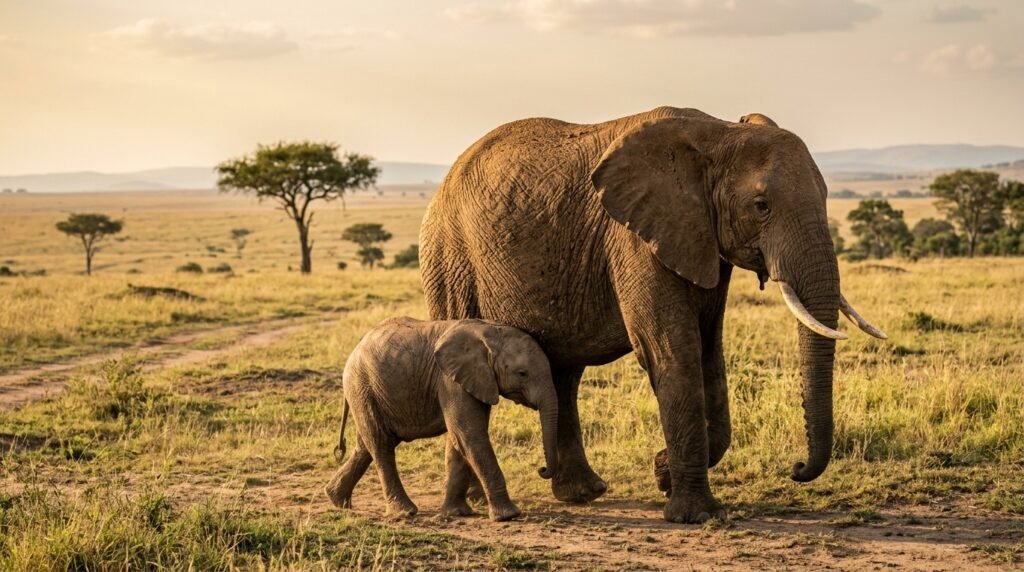
Elephants communicate through more than the dramatic trumpet that often appears in wildlife documentaries. Their vocal repertoire includes rumbles, roars, cries, and other calls. Some sounds are loud and obvious; others are low and subtle. The low-frequency components of certain rumbles can fall below the usual lower limit of human hearing, which means people standing nearby may not perceive the full signal.
These calls are part of a broader sensory world. Elephants also use sight, smell, touch, and movements of the body. A greeting between familiar elephants may involve several kinds of signals at once. A trunk gesture, a change in posture, scent information, and a vocalization can all contribute to the interaction.
Low-frequency sound is particularly useful across open or semi-open landscapes because it can carry over distances. It does not mean every low rumble travels a fixed number of kilometres; the distance depends on the call, the environment, weather, and background noise. But it helps explain how elephants can remain connected when members of a family group are not standing side by side.
For researchers, recording these sounds is a demanding task. A call must be linked to the correct caller and, ideally, to the individual receiving it. Observers need to recognize animals, follow their movements, and document the social context. Long-term field projects make this possible because researchers become familiar with individual elephants and their relationships over time.

Are Elephant Names Really Like Human Names?
The comparison is useful, but it needs careful boundaries. A human name is a conventional label that can be spoken, written, remembered, and used in many kinds of sentences. The elephant study identified calls with acoustic features associated with individual receivers. It did not isolate a neat, separate word that researchers could write down and pronounce.
Nor did the researchers demonstrate that elephants have a vocabulary of names in the same sense that humans do. The calls are complex vocalizations, and the name-like information may be one component within a larger sound. Scientists still need to understand exactly how the labels are produced, how they are learned, and whether different callers use the same label for the same receiver.
Even so, the comparison matters because of the possible role of arbitrary vocal labels. A label is arbitrary when its sound does not simply resemble the thing or individual it refers to. Human words often work this way: the sound of a person’s name does not need to imitate the person’s voice. The elephant findings suggest a similar principle may exist in another highly social species.
If elephants can use sounds that identify others without copying their voices, that raises questions about the evolution of communication. Perhaps complex social relationships create pressure for more precise ways of directing messages. In a group where individuals maintain long-lasting bonds and interact across changing social arrangements, identifying the intended recipient could be valuable.

What the Discovery Does—and Does Not—Tell Us
The strongest conclusion is also the most measured one: the study provides evidence that wild African elephants address one another with individually specific, name-like calls, and that elephants respond differently to calls directed toward them than to calls directed toward other individuals.
It does not mean scientists can now translate elephant conversations. It does not prove that elephants name objects, places, or events. It does not show that every elephant has one fixed name used by every other elephant. And it does not establish that elephant communication has grammar or sentence structure comparable to human language.
The researchers themselves emphasized that more data are needed. A larger body of recordings could help scientists isolate the name-like components more precisely. Further work could investigate whether labels remain stable over time, whether different callers use similar labels for the same elephant, and how young elephants learn to produce or recognize them.
Another open question is whether elephants use labels for things beyond other elephants. Do they have specific calls associated with food, water, or familiar places? The current study does not answer that. It offers a starting point for asking how much information elephant calls can carry and how flexibly elephants use it.

A New Perspective on Animal Intelligence
For a long time, language was often treated as a sharp dividing line between humans and other animals. Research on dolphins, parrots, primates, and now elephants has made that picture more complicated. Other species do not speak as humans do, but they can show sophisticated ways of identifying individuals, learning signals, and coordinating social behaviour.
The elephant discovery is especially striking because the animals live in societies where relationships matter. Their calls are not simply background noise in the savanna. They are part of a social system that helps individuals maintain contact, respond to one another, and navigate a world in which family members may be near or far.
It also reminds us that intelligence does not always announce itself in ways humans immediately recognize. A sound that seems like an ordinary rumble to a person may carry information that another elephant can identify. The challenge for science is to develop methods that reveal those signals without assuming that animal communication must resemble our own.
Perhaps the most remarkable part of the story is not that elephants have names exactly like ours. It is that a species separated from humans by a vast evolutionary distance appears to have developed a way to address individuals with learned, name-like sounds. In the open landscapes of Kenya, a low rumble may be doing something much more personal than simply announcing that an elephant is nearby.
Frequently Asked Questions
Do elephants have names for each other?
A 2024 study found evidence that wild African elephants use individually specific, name-like calls to address particular members of their social groups. The researchers have not translated these calls into human words.
How did scientists discover elephant names?
Researchers analysed 469 recorded calls using machine learning, then conducted playback experiments. The acoustic structure helped predict the intended receiver, and elephants responded more strongly to calls originally directed toward them.
Do elephants copy the voice of the elephant they are calling?
The evidence suggests that elephant name-like calls do not simply imitate the receiver’s own vocalizations. This distinguishes the proposed system from some known forms of vocal labelling in dolphins and parrots.
Can humans hear elephant communication?
People can hear many elephant calls, but some components of their rumbles are infrasonic—below the usual range of human hearing.
Can scientists translate elephant language now?
No. The study identifies evidence for individual addressing, not a complete dictionary or translation system. Much more research is needed to understand the full meaning of elephant calls.
Keep Reading
References
1. Pardo, M. A. et al. (2024). “African elephants address one another with individually specific name-like calls.” Nature Ecology & Evolution, 8, 1353–1364. https://doi.org/10.1038/s41559-024-02420-w
2. Pardo, M. A. et al. (2025). “Author Correction: African elephants address one another with individually specific name-like calls.” Nature Ecology & Evolution, 9, 1527–1528. https://doi.org/10.1038/s41559-025-02823-3
3. Colorado State University (2024). “Elephants have names for each other like people do, new study shows.” Research summary.
4. Nature Ecology & Evolution (2024). “African savannah elephants call one another by ‘name’.” Research briefing.
5. Pardo, M. A. et al. (2024). Study data repository, Dryad. https://doi.org/10.5061/dryad.hmgqnk9nj.