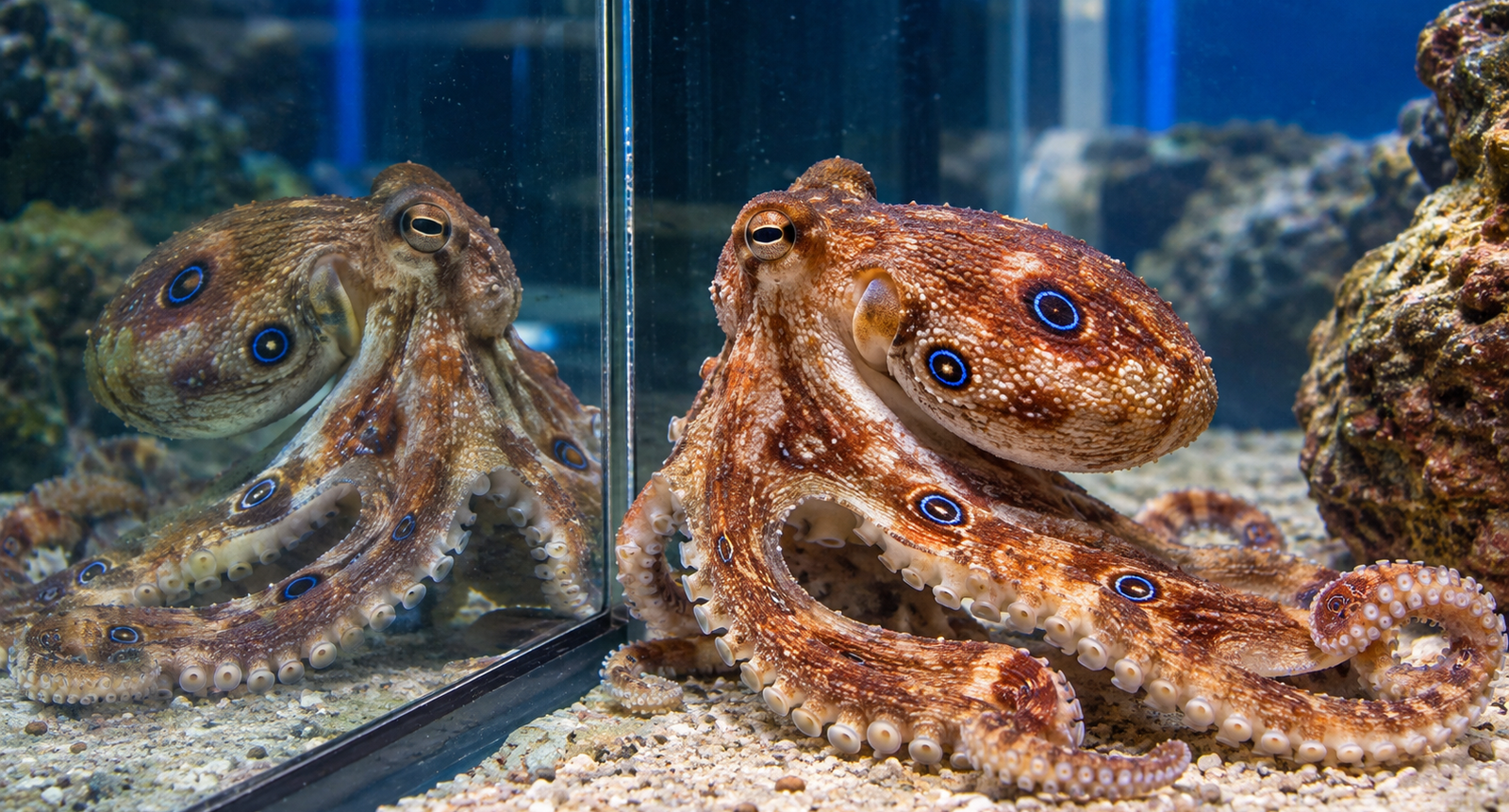
At first, the octopus did exactly what a researcher might expect from an animal encountering a strange reflection: it moved toward the mirror. The image seemed to show a crab, and a crab is food. But the real challenge was not to reach the glass. It was to work out where the crab actually was.
In a laboratory at Dartmouth College, researchers presented California two-spot octopuses with a visual puzzle. A crab-like image appeared behind an animal, but the octopus could see it only in a mirror placed in front of it. To earn a food reward, the animal had to do something more complicated than follow the image: it had to use the reflection to locate a target outside its direct line of sight, then travel to the target’s real position.
All three octopuses in the experiment learned to solve the task. Across the trials, they chose the correct side about 73 percent of the time. The result, published in Current Biology in June 2026, was the first demonstration that an invertebrate could use a mirror reflection to locate an otherwise hidden object.
It is an extraordinary finding—but its meaning is easy to overstate. The study did not show that octopuses recognize themselves in mirrors. Instead, it revealed a different and more specific ability: they can learn that a reflection provides information about the position of something in the surrounding world. That distinction matters, because using a mirror to find food and recognizing one’s own reflection are two separate scientific questions.
The California Two-Spot Octopus: A Curious Animal with an Unusual Brain
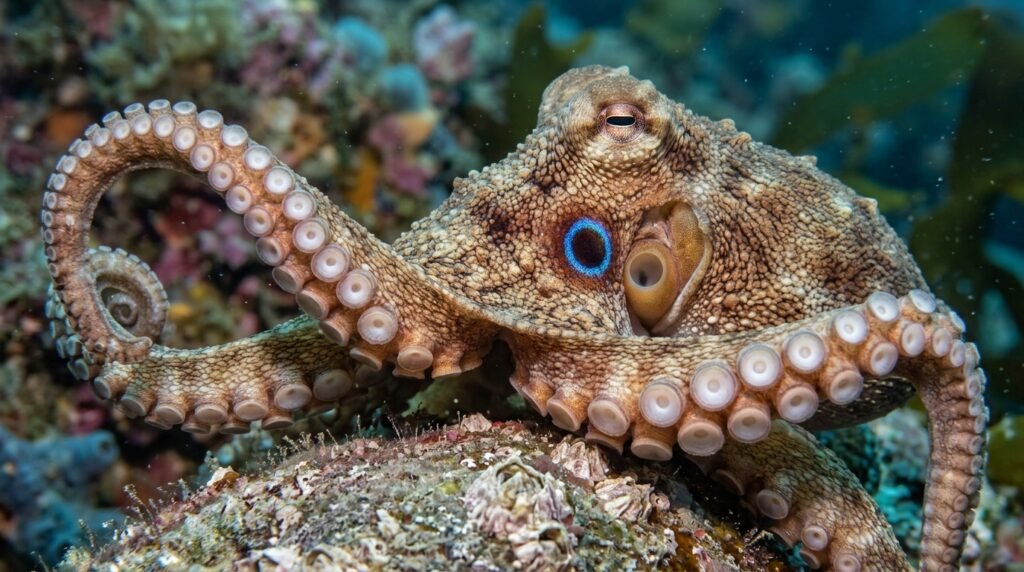
The animal at the centre of the experiment was Octopus bimaculoides, commonly known as the California two-spot octopus. Native to the eastern Pacific, it is recognizable by the pair of blue-ringed spots on either side of its head. Like other octopuses, it has no shell to protect it. Its flexible body, powerful arms, and remarkable ability to change its appearance help it move through a complex underwater environment.
An octopus does not explore the world in quite the same way a human does. Its eight arms are lined with suckers that can grip, taste, and sense objects. Its skin contains specialized cells that allow rapid changes in colour and pattern. And its nervous system is unusually distributed: a large proportion of its neurons are located outside the central brain, including in the arms.
Estimates for the common octopus, Octopus vulgaris, place its nervous system at roughly half a billion neurons, with hundreds of millions distributed through the arm nerve cords. Those figures should not be treated as an exact count for every octopus species, but they illustrate how unusual cephalopod nervous systems are. The arms are not simply passive tools waiting for detailed instructions; they can process substantial amounts of sensory information locally while remaining connected to the central brain.
This arrangement helps explain why octopuses have become important animals in the study of learning, memory, and problem-solving. Researchers have documented abilities such as learning associations, remembering locations, and adapting behaviour when a task changes. The mirror experiment adds a new kind of problem to that growing picture.
Why a Mirror Is More Complicated Than It Looks
For people, a mirror is an ordinary object. We learn early that the person or object in the glass is not physically inside it. The reflection is information about something located elsewhere. But that relationship is not automatically obvious to every animal.
An animal may approach a reflection as if it were another individual. It may investigate the glass, display social or defensive behaviour, or lose interest after discovering that the image does not behave like a real animal. None of these reactions, on its own, tells researchers whether the animal understands what a mirror represents.
Scientists therefore distinguish several abilities that are sometimes blurred together in popular accounts. An animal might notice a reflection, learn that it corresponds to something in the environment, use it to guide movement, or recognize the reflected image as its own body. These are not interchangeable achievements.
The best-known test of mirror self-recognition is often called the mark test. In a typical version, researchers place a visible mark on a part of an animal’s body that it cannot normally see directly. They then observe whether the animal uses the mirror to investigate the mark on its own body. Even this test has limitations: species differ in how they use vision, touch, smell, and other senses, so a single test cannot provide a complete measure of an animal’s mind.
The Dartmouth team chose a different starting point. Rather than asking whether an octopus could recognize itself, the researchers asked a narrower question: could it learn to use a reflection as a source of information about where food was located?
Inside the Mirror Experiment
The researchers first had to make the mirror a familiar, non-threatening part of the octopuses’ surroundings. An unfamiliar reflection might be treated as a possible rival or simply as an unusual stimulus. Before testing mirror-guided navigation, the animals were acclimated to the mirror and trained to understand the relationship between what appeared in it and the layout of the tank.
In an early training stage, a real crab was placed inside a glass jar that the octopus could see in the mirror. The jar was positioned so that the animal had to move around a corner to reach it. The reward encouraged the octopus to connect the reflected image with the location of the actual food rather than repeatedly trying to grab the image itself.
For the main task, the researchers used a virtual crab rather than a live one as the visual target. This was an important control. Octopuses have chemical senses that allow them to detect substances through contact, and the researchers did not want the smell or taste of a real crab to reveal its location. A projected image could provide a visual cue without giving away the answer through chemical information.
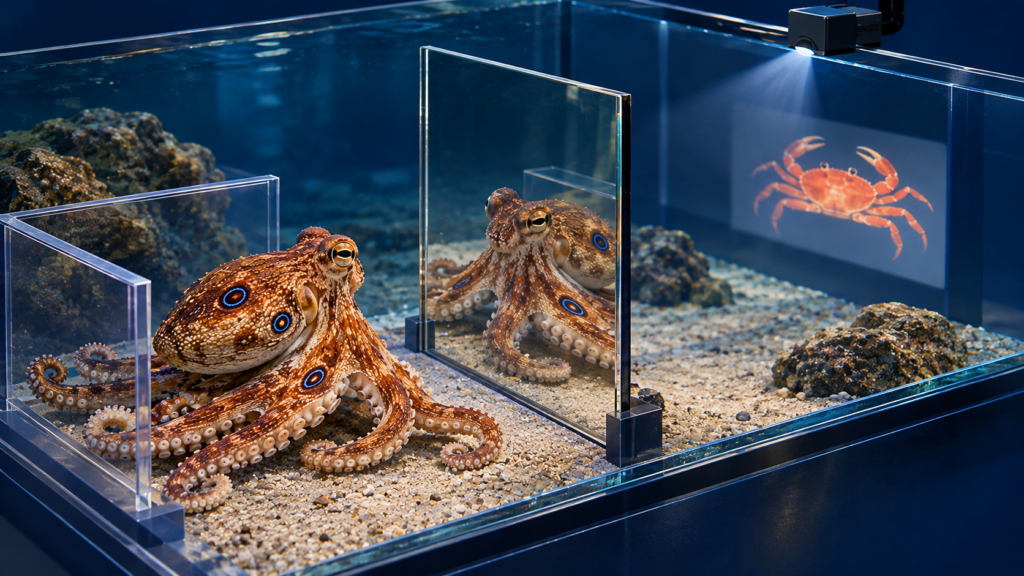
Each octopus began inside a small start chamber. A mirror stood in front of it, while the virtual crab was projected onto a surface behind the animal, to its left or right. The crab image could be seen only in the mirror. The octopus therefore had to use the reflection to work out which side of the tank contained the target, leave the chamber, and move toward the projected location—not toward the mirror itself.
The arrangement turned a simple-looking reflection into a spatial problem. The animal had to connect three things: the image in the mirror, the physical layout of the tank, and the direction it needed to travel to reach the reward.

What the Octopuses Actually Did
The result was striking. All three octopuses learned to use the mirror cue and selected the correct side in approximately 73 percent of trials. Their performance was not perfect, and the researchers did not claim that it was. But the animals were doing more than approaching a visually attractive image: they were using the reflection to guide movement toward a location that they could not see directly.
Some of the routes were especially revealing. Rather than always leaving the start chamber in the most obvious way and travelling around it, an octopus sometimes climbed over a side wall to reach the side associated with the reflected crab. The behaviour suggested that the animals were not simply following a fixed movement sequence. They could adjust their route in relation to the target’s inferred location.
The researchers also found that the animals became faster at reaching the relevant side as the trials progressed. That improvement is consistent with learning: experience helped the octopuses use the mirror information more efficiently.
Still, the numbers need context. The experiment involved only three animals, and the task was conducted under controlled laboratory conditions after training. The result is a promising first demonstration, not proof that every octopus can solve the same problem in the wild or that octopuses possess a human-like understanding of mirrors.
What Does It Mean to Use a Reflection?
The key scientific idea is sometimes described as mirror-mediated perception. Instead of treating the reflection as the object itself, an animal uses it as a clue to the position of something beyond the mirror. In everyday terms, it is similar to using a rear-view mirror to notice a vehicle behind you: the image is not the vehicle’s physical location, but it tells you where to look and how to respond.
For the octopuses, the task required them to resist the most direct response to the image. The crab appeared in the mirror, but the reward was not inside the mirror. The animals had to use the reflected information to select a real route through the tank.
This is why the study matters for the science of animal cognition. Mirror-guided navigation had previously been demonstrated in some vertebrates, but this experiment extended the ability to an invertebrate. Octopuses and vertebrates evolved very different nervous systems over hundreds of millions of years. If both can develop ways of using reflected information to solve spatial problems, that may be an example of convergent evolution: different evolutionary paths producing similar solutions to a practical challenge.
That does not mean an octopus thinks like a human, a bird, or a mammal. It means that sophisticated behaviour does not have to arise from a brain built on the same blueprint as ours. Different nervous systems can arrive at useful ways of processing information.
The Mirror Test Is Not the Same as Self-Recognition
Because the experiment involved a mirror, headlines can easily turn it into a story about self-awareness. That would go beyond the evidence.
Mirror self-recognition asks whether an animal identifies the reflected body as its own. Mirror-guided navigation asks whether an animal can use a reflection to locate something else. The 2026 experiment tested the second ability, not the first.
This distinction is especially important because an earlier study examined how common octopuses responded to their reflections. Published in Frontiers in Physiology in 2022, that preliminary investigation involved eight common octopuses and explored whether a mark-test procedure could be adapted for the species. The researchers found that the results were difficult to interpret: some mark-directed behaviour also occurred without a mirror or in sham-marked animals. The authors therefore described the work as preliminary and did not claim that octopuses had passed the mirror self-recognition test.
The newer study does not settle that older question. Instead, it gives scientists a clearer experimental route for investigating how octopuses interpret reflected information. Future research may build on it, but self-recognition would require its own carefully designed tests and evidence.

A Nervous System Built on a Different Plan
One reason the finding is so interesting is that octopus intelligence developed along a very different evolutionary path from human intelligence. Octopuses are molluscs, more closely related to snails and clams than to vertebrates. Their last common ancestor with humans lived hundreds of millions of years ago.
Yet octopuses evolved large, complex nervous systems and flexible behaviour. Their arms are sensory organs as well as manipulators. Their suckers can explore surfaces and handle objects, while the central brain integrates information from the arms and senses. This distributed arrangement does not make the arms independent thinkers in the human sense, but it does allow local processing that is unusual among animals.
Their visual world is also different from ours. Octopuses rely heavily on vision, but their skin can change colour and texture through a sophisticated system controlled by the nervous system. Camouflage is not simply a passive colour change: it can involve rapid adjustments that help the animal blend into rocks, sand, or coral. Such abilities show how perception, movement, and decision-making are closely linked in an animal that must navigate a complex underwater habitat.
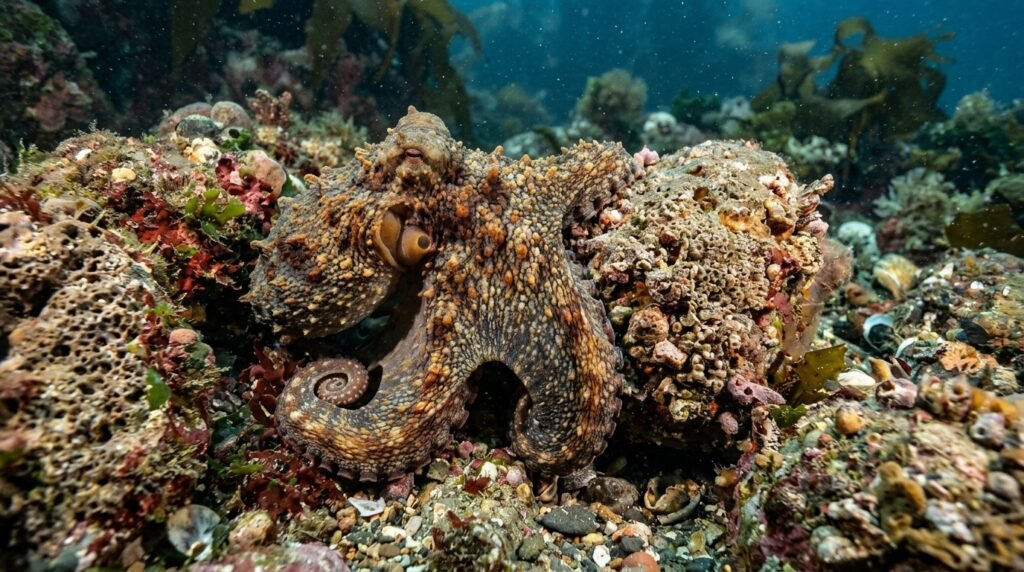
For a predator that hunts among reefs and rocky seafloors, knowing where something is—even when it is partly hidden—can be useful. A reflection is not a natural hunting tool in most underwater settings, but the experiment tested whether the octopus could learn a new relationship between a visual cue and a real location. The result suggests that its cognitive abilities may be flexible enough to handle problems beyond the exact situations it encounters in nature.
What Scientists Still Need to Find Out
The study opens several questions. Would other octopus species learn the same task? Would animals with different life histories or levels of experience perform differently? How much training is required, and which parts of the task are most difficult: understanding the reflection, remembering the tank layout, or choosing a route?
Researchers will also need to test how robust the result is with larger samples and different experimental designs. Three animals are enough to make a compelling first demonstration, but not enough to establish how widespread the ability is across octopuses. Repetition by independent research teams would help show how reliable the finding is.
Another question concerns the mental representation involved. Did the octopuses build a detailed spatial map of the tank, or did they learn a more limited rule linking the reflection’s position to the correct direction? The observed routes are consistent with flexible spatial processing, but further experiments are needed to distinguish between possible explanations.
Finally, the work raises a broader question about intelligence itself. Scientists often study cognition through tests originally designed around human abilities. But an animal’s most impressive skills may be expressed in ways that fit its own body and environment. For an octopus, solving a problem with eight flexible arms, sensitive suckers, and a distributed nervous system may reveal more than asking it to imitate a human response.

Why This Discovery Matters
The mirror experiment is not a claim that octopuses have human-like self-awareness. Its significance is more precise—and, in its own way, just as fascinating. It shows that an invertebrate can learn to use a reflection to locate something hidden from direct view, then adapt its movement to reach that location.
For scientists, the result expands the range of animals known to use mirror information in this way. It also challenges the assumption that complex spatial skills must depend on a vertebrate-style brain. The octopus arrived at the task with a very different nervous system, yet it learned to solve the problem.
There is still much to discover about how octopuses perceive their surroundings, remember locations, and make decisions. The mirror did not reveal the whole of the octopus mind. It offered researchers a new window into it—and a reminder that intelligence has evolved in forms far more varied than our own.
Frequently Asked Questions
Can octopuses recognize themselves in a mirror?
The 2026 study did not test self-recognition. It showed that California two-spot octopuses could learn to use a mirror reflection to locate a hidden target.
Which octopus species took part in the experiment?
The researchers studied California two-spot octopuses, Octopus bimaculoides.
How successful were the octopuses?
The three animals selected the correct side in approximately 73 percent of trials.
Why did researchers use a virtual crab?
A projected image provided a visual target without allowing the octopuses to locate a real crab through chemical cues such as smell or taste.
Does the experiment prove that octopuses are self-aware?
No. Mirror-guided navigation and mirror self-recognition are different abilities. The experiment demonstrated the former, not the latter.
Keep Reading
References
1. Kieseler, M. et al. (2026). “Octopus bimaculoides can learn to utilize a mirror to localize a reward outside the line of sight.” Current Biology, 36(12), 3142–3147. https://doi.org/10.1016/j.cub.2026.05.012
2. Dartmouth College (2026). “Study Shows Octopuses’ Impressive Ability to Navigate Space.” Dartmouth research summary.
3. Amodio, P. & Fiorito, G. (2022). “A preliminary attempt to investigate mirror self-recognition in Octopus vulgaris.” Frontiers in Physiology, 13, 951808. https://doi.org/10.3389/fphys.2022.951808
4. Albertin, C. B. et al. (2015). “The octopus genome and the evolution of cephalopod neural and morphological novelties.” Nature, 524, 220–224. https://doi.org/10.1038/nature14668
5. “Cephalopod learning and memory.” (2023). Current Biology, 33(20), R1091–R1095. https://doi.org/10.1016/j.cub.2023.08.013