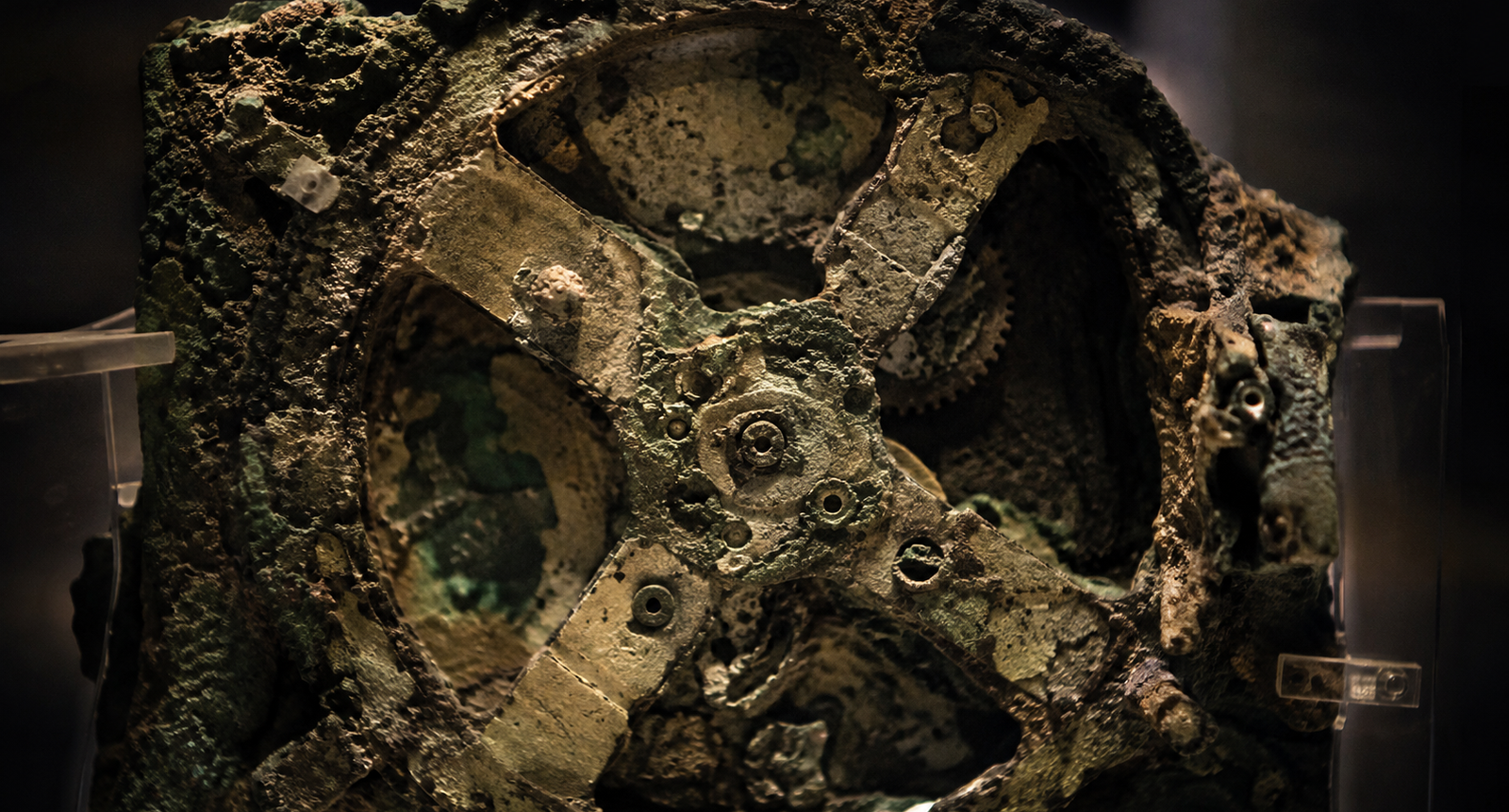
In the winter of 1900, a group of Greek sponge divers working off the small island of Antikythera found the remains of an ancient ship on the seabed. Statues, glassware and other valuable cargo lay scattered across the wreck. Among the objects brought to the surface was a corroded lump of bronze. It looked unremarkable beside the sculptures. But when researchers examined it more closely, they noticed something extraordinary: the edges of tiny toothed wheels, locked together inside a device that had been underwater for roughly two thousand years.
The object became known as the Antikythera Mechanism. It was a hand-operated astronomical calculator made in ancient Greece, probably during the second century BCE. Its gears translated mathematical cycles into moving displays of celestial patterns. It did not think, observe the sky, or operate by itself. Instead, it allowed a user to model selected movements of the heavens with a precision and mechanical complexity that surprised modern researchers.
The mechanism is often called the world’s oldest known analogue computer. That description is useful if it is understood carefully: this was a machine for representing and calculating astronomical cycles, not an electronic computer or a general-purpose calculating machine. Its true significance is even more compelling. It is physical evidence that ancient engineers could turn sophisticated mathematical astronomy into an intricate working instrument.
In this article
- A shipwreck discovery that changed the story
- What exactly was the Antikythera Mechanism?
- How modern imaging revealed hidden details
- The Moon: a difficult problem solved in bronze
- Predicting eclipses with the Saros cycle
- Did it display all five known planets?
- A calendar for a world organized by the sky
- Who built it—and where?
- Why did machines like it not survive in large numbers?
- What remains uncertain
- The real mystery is human ingenuity

A shipwreck discovery that changed the story
The wreck was discovered in 1900 by sponge divers from the Greek island of Symi, who were working in the Mediterranean near Antikythera. The recovery operation continued into 1901 with the involvement of the Greek authorities. It was a difficult undertaking using the diving equipment available at the time. The divers recovered remarkable works of art and everyday objects from a cargo ship that had probably been travelling through the eastern Mediterranean when it sank.
The bronze fragments were not immediately recognized as a sophisticated instrument. In 1902, archaeologist Valerios Stais noticed a gear wheel embedded in one of the corroded pieces. That observation changed the interpretation of the object. The fragments were not simply decorative bronze; they belonged to a geared mechanism. The shipwreck gave the device its modern name, but the instrument itself had been made long before the vessel sank.
The wreck is generally dated to the first century BCE, while the mechanism is usually dated to the second century BCE. Researchers cannot assign it a single exact year of manufacture. Its inscriptions, astronomical cycles and archaeological context help establish a broad period, but the precise workshop, maker and original owner remain unknown.
The surviving object is badly damaged. Its wooden case has disappeared, and seawater, corrosion and pressure have transformed the bronze. Today the mechanism is divided into 82 known fragments. Around 30 gear wheels survive, many of them corroded or incomplete. That such a complex instrument can still be studied at all is remarkable.
What exactly was the Antikythera Mechanism?
At its core, the mechanism was a compact system of interlocking bronze gears. A user could turn a control, causing pointers and displays to move according to carefully chosen gear ratios. Those ratios represented repeating astronomical periods: the time between lunar phases, the relationship between lunar months and solar years, and cycles associated with eclipses. The machine converted abstract numerical relationships into visible mechanical motion.
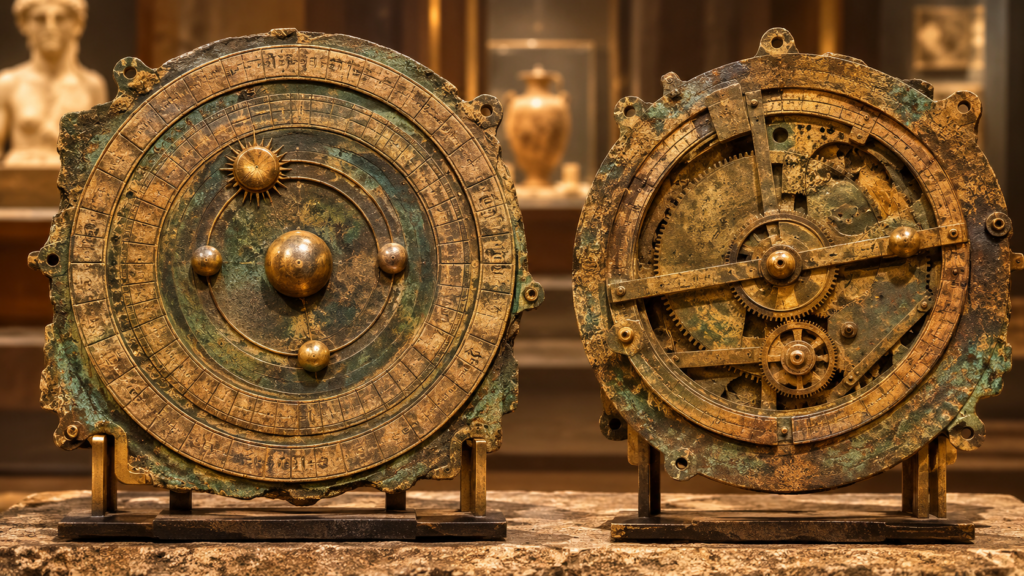
The original instrument was probably enclosed in a wooden case with inscriptions on its front and back. The front is understood to have displayed a representation of the cosmos, while the back carried spiral dials for longer cycles. The surviving inscriptions are not decoration. They are part of the evidence that allows researchers to infer how the machine was intended to work.
A gear ratio is the relationship between the number of teeth on two connected wheels. If a small gear turns a larger one, the two rotate at different speeds. By combining several ratios, a designer can represent a long period of time in a small mechanism. The Antikythera device used this principle to reproduce astronomical cycles that would otherwise require repeated observation and calculation.
This was not a simple clockwork toy. The design required a detailed understanding of the cycles being represented, the mathematics needed to express them, and the practical craft of cutting and fitting small bronze gears. The surviving fragments show that the maker had to solve both theoretical and mechanical problems.
How modern imaging revealed hidden details
For decades, researchers could examine only the surfaces of the fragments and the parts that were visible through corrosion. A major advance came in 2005, when an international research team used high-resolution surface imaging and microfocus X-ray computed tomography. X-rays made it possible to examine the internal structure without taking the mechanism apart. They revealed gear teeth, hidden components and thousands of tiny inscription characters that could not be read from the surface.
A landmark 2006 study in Nature described how the mechanism predicted lunar and solar eclipses using cycles related to Babylonian arithmetic astronomy. It also identified a mechanical representation of the Moon’s changing apparent motion. The research showed that the mechanism was more sophisticated than a simple calendar and that its inscriptions supported the idea of lost planetary displays.
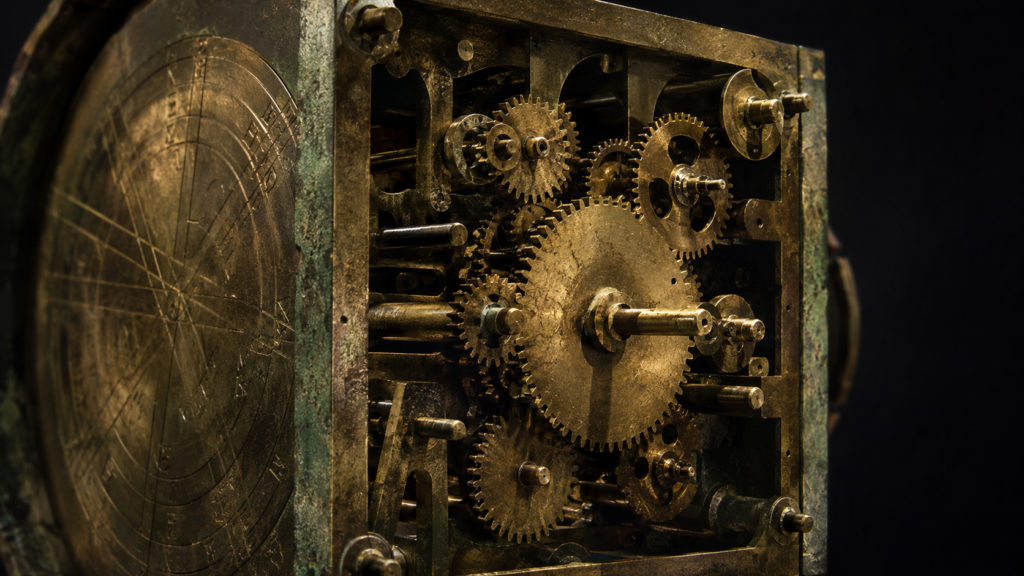
The imaging did not magically restore the missing machine. It provided new evidence from which researchers could build and test reconstructions. That distinction matters. Some functions are strongly supported by surviving gears and inscriptions; other details, especially on the damaged front display, require models that remain open to revision.
The Moon: a difficult problem solved in bronze
The Moon does not appear to move across the sky at a perfectly constant speed. Its orbit is slightly elliptical, so its apparent motion changes over the course of a month. Ancient astronomers had studied this irregularity, and the mechanism contains a gear arrangement that models it. The system is associated with the work of the Greek astronomer Hipparchus, although the identity of the mechanism’s maker is not known.
The device also represented the Moon’s phases. The familiar cycle from new Moon to full Moon and back again is a repeating pattern, but connecting it mechanically to the Moon’s changing position required careful design. The mechanism’s lunar display is one of the clearest demonstrations that its gears encoded astronomical ideas rather than merely turning at arbitrary speeds.
The back of the mechanism included a spiral dial associated with the Metonic cycle. Nineteen solar years are close to 235 lunar months, so after that interval lunar phases return to approximately the same dates in the solar calendar. This relationship helped ancient societies coordinate calendars based on the Moon with the seasons and the solar year.
Predicting eclipses with the Saros cycle
Another important back display represented the Saros cycle, a period of about 18 years, 11 days and 8 hours. After one Saros, the geometry of the Sun, Earth and Moon returns to a similar arrangement, making a related eclipse possible. The extra eight hours mean that the Earth has rotated by roughly one-third of a turn, so the next eclipse in the series is generally visible from a different region.
The mechanism’s eclipse-prediction display did not mean that its user could forecast every detail with modern precision. It represented recurring patterns and included information associated with eclipse possibilities and timing. The achievement was to make a long astronomical cycle tangible through a compact mechanical system.
The Metonic and Saros cycles also reveal that the instrument drew on a wider history of mathematical astronomy. Babylonian scholars had developed highly effective ways of recording and predicting celestial cycles. Greek astronomers worked with those traditions and developed geometrical models of their own. The mechanism is a rare physical example of knowledge crossing cultural boundaries and being transformed into an engineered object.
Did it display all five known planets?
The five planets visible to the naked eye—Mercury, Venus, Mars, Jupiter and Saturn—were known in antiquity. Their apparent movements are more complicated than the annual path of the Sun or the monthly cycle of the Moon. The mechanism’s inscriptions refer to the planets and to cycles associated with their motions. That evidence has led researchers to investigate how a planetary display could have fitted into the front of the device.
A 2021 study in Scientific Reports proposed a detailed model of the front display. The authors described a system of rings and outputs representing the Moon, lunar nodes, the five planets, the Sun and the date. Their reconstruction uses the surviving evidence and the inscriptions to propose how the missing planetary gearing might have worked. It is an influential scholarly model, but it is still a reconstruction—not a surviving complete original.

This is where popular accounts sometimes go too far. It is reasonable to say that the mechanism was designed to represent planetary motions. It is less careful to describe every modern reconstruction as if it were a photograph of the original. Large portions of the front are missing, and researchers continue to debate how best to reconcile the physical evidence, the inscriptions and the available space inside the case.
A calendar for a world organized by the sky
Astronomy in the ancient Mediterranean was not separate from ordinary life. Calendars helped communities plan religious festivals, civic events, agricultural activity and athletic competitions. The mechanism appears to have included a display associated with the cycle of the Panhellenic games, including the Olympic festival. That feature is a reminder that the instrument connected the abstract study of the heavens with the social calendar of Greek communities.
The device may therefore have served more than one purpose. It could demonstrate astronomical knowledge, help users explore cycles, and display calendar information. Whether it was built for an individual patron, a scholar, a wealthy collector or a teaching environment is not known. Its craftsmanship suggests an object of considerable value, but the surviving evidence does not identify the person who commissioned it.
Who built it—and where?
No inscription securely names the person who designed or assembled the mechanism. Famous ancient scientists are sometimes proposed as possible influences, but there is no firm basis for declaring that Archimedes, Hipparchus or another named figure personally built it. The mechanism reflects a sophisticated intellectual environment; it does not provide a signature.
Its design brings together several traditions: Babylonian cycles, Greek mathematical astronomy, and the skilled metalworking needed to produce small, accurate gears. The 2021 reconstruction discusses connections with Babylonian astronomical periods and mathematical ideas associated with Greek thinkers. This is a reminder that ancient science was collaborative across time and geography. A device could embody generations of observation and calculation even if its individual maker remains unknown.
Why did machines like it not survive in large numbers?
The Antikythera Mechanism is often presented as a technology that appeared centuries too early and then vanished. That framing is dramatic, but the archaeological record is incomplete. Bronze was valuable and could be melted down and reused. Wooden cases decay. Shipwrecks, fires, wars and ordinary wear destroy fragile objects. A complex instrument might also have been made in very small numbers for specialists or wealthy patrons.
Ancient writers describe mechanical devices and geared instruments, and other surviving artifacts show that ancient engineers understood gearing, automata and precise measurement. The Antikythera Mechanism is exceptional because so much of its internal design survives—not necessarily because it was the only such device ever made. We cannot infer the full scale of an ancient technology from a single shipwreck find.
What remains uncertain
Only a fraction of the original machine survives. The missing gears and case leave open questions about its complete appearance, the exact arrangement of every display, its place of manufacture and its intended use. Some interpretations are supported by physical gear evidence; others depend on inscriptions or mathematical models. Good scholarship makes those differences clear rather than presenting every reconstruction as settled fact.
There is also uncertainty about how the device was used in practice. We do not know how many people could operate one, whether it was used regularly or mainly as a demonstration, or how its knowledge was passed between workshops. The mechanism tells us what ancient engineering could achieve, but it cannot answer every question about the society that produced it.
The real mystery is human ingenuity
The Antikythera Mechanism does not need an impossible origin story. Its significance lies in what it reveals about people who lived more than two thousand years ago. They observed the heavens, recognized repeating cycles, expressed those cycles mathematically and built a machine that translated them into moving parts. It joins astronomy, mathematics, craftsmanship and practical design in a single surviving object.
Modern imaging has allowed researchers to recover details that were hidden for centuries, and new models continue to test what the fragments can tell us. Each reconstruction is a conversation between ancient evidence and modern analysis. The device remains incomplete, but its surviving gears are enough to overturn the idea that sophisticated mechanical thinking belongs only to the modern age.
The most extraordinary part of the story is not that the mechanism seems modern. It is that it is unmistakably ancient—and that the people who made it understood enough about the sky and about machines to build a miniature mechanical model of the cosmos.
Explore more from TheOddNova
For another journey into ancient engineering and archaeological puzzles, read Top 10 Ancient Mysteries That Still Baffle Scientists Today.
Sources and further reading
- Freeth et al. (2006), Nature — Decoding the ancient Greek astronomical calculator known as the Antikythera Mechanism
- Seiradakis & Edmunds (2018), Nature Astronomy — Our current knowledge of the Antikythera Mechanism
- Freeth et al. (2021), Scientific Reports — A Model of the Cosmos in the ancient Greek Antikythera Mechanism