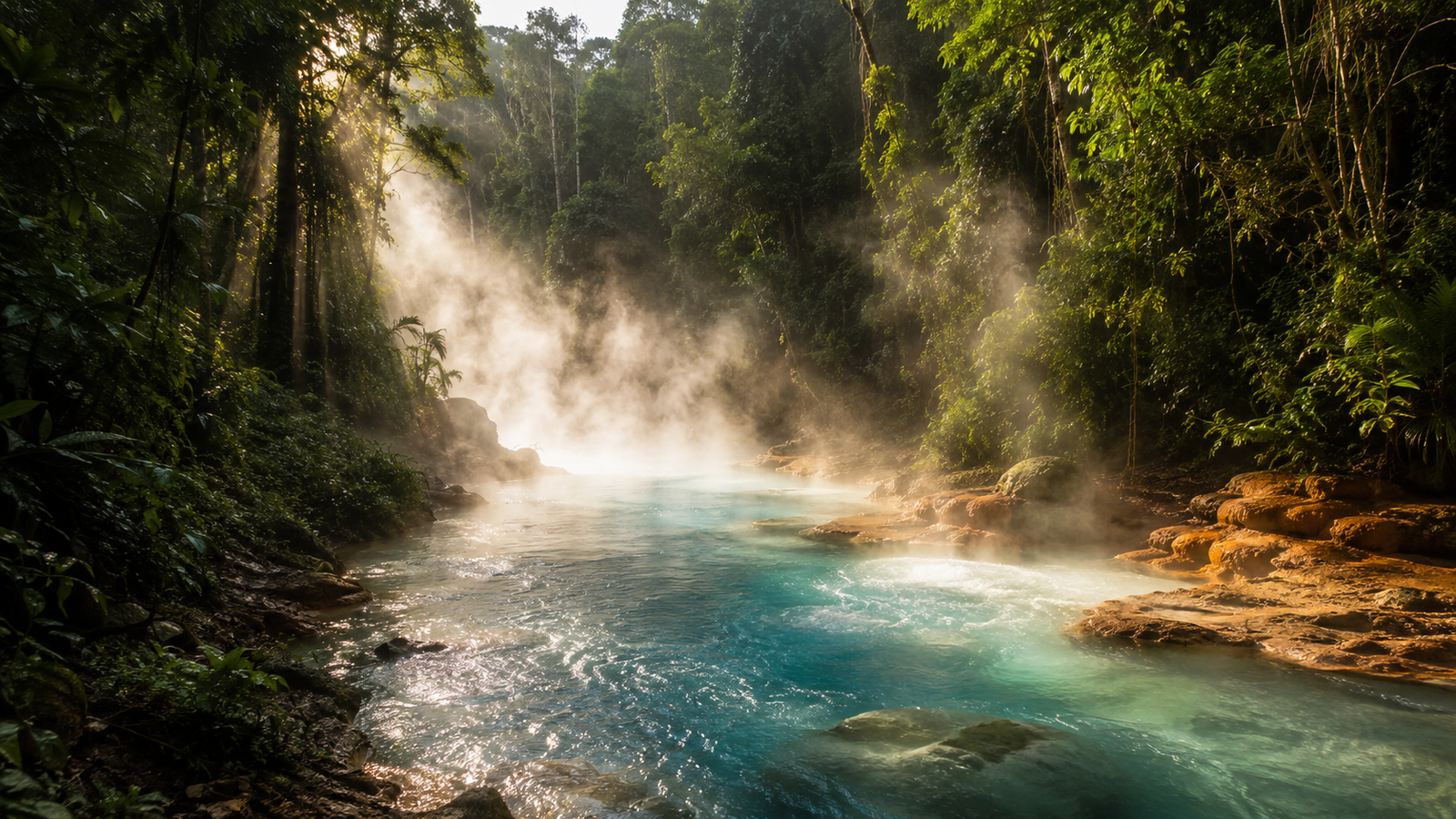
Imagine an Earth with no forests, no animals walking across continents, and no blue sky filled with the oxygen-rich air we breathe today. The planet was already alive, but its oceans and atmosphere belonged to a very different world. Then, over an immense stretch of geological time, oxygen began to accumulate in the air. The change was not a single dramatic breath taken by the planet. It was a complex transition recorded in ancient rocks, chemical signatures and the changing behavior of the oceans.
This transformation is known as the Great Oxidation Event, or GOE. It began around 2.4 billion years ago, near the start of the Proterozoic Eon. For the first time, oxygen produced by life became a lasting component of Earth’s atmosphere at levels that changed the planet’s surface chemistry. The event reshaped ecosystems, altered the oceans, affected climate and helped establish conditions under which more complex forms of life would eventually evolve.
The story is often simplified to a single claim: tiny bacteria filled the atmosphere with oxygen and made complex life possible. That is broadly connected to the truth, but the real history is more interesting. Oxygen-producing photosynthesis likely evolved before the atmosphere changed permanently. Oxygen was consumed by reactions with rocks, dissolved metals and volcanic gases. The Great Oxidation Event happened when the balance between biological production and the planet’s many oxygen-consuming processes shifted enough for oxygen to persist.
A planet before the oxygen we know
Earth formed about 4.54 billion years ago. Its earliest atmosphere was not like the one surrounding us today. Free molecular oxygen, O₂, was scarce. The atmosphere and oceans were chemically reducing compared with modern conditions, and many of the minerals that are unstable in oxygen-rich environments could persist at Earth’s surface.
Life appeared long before the Great Oxidation Event. The oldest evidence for life is debated in detail, but microbial ecosystems existed billions of years before oxygen became a permanent atmospheric feature. Early organisms used metabolisms that did not require oxygen. Some extracted energy from chemical reactions involving substances such as hydrogen, sulfur compounds, iron and carbon dioxide. In an anoxic world, oxygen was not the universal requirement for life that it is for many organisms today.
The oceans were also different. Large amounts of dissolved ferrous iron could remain in seawater under low-oxygen conditions. In some places, local pockets of oxygen may have existed near microbial communities even while the atmosphere as a whole remained oxygen-poor. This distinction between local oxygen oases and a globally oxygenated atmosphere is essential to understanding the event.
The microscopic organisms that changed the planet
A major source of Earth’s oxygen is oxygenic photosynthesis. Organisms using this process capture energy from sunlight and use it to help convert water and carbon dioxide into organic matter, releasing molecular oxygen as a by-product. Cyanobacteria are the best-known ancient organisms associated with this metabolism. They are bacteria, not plants, although their photosynthetic activity helped create the conditions in which later photosynthetic life flourished.
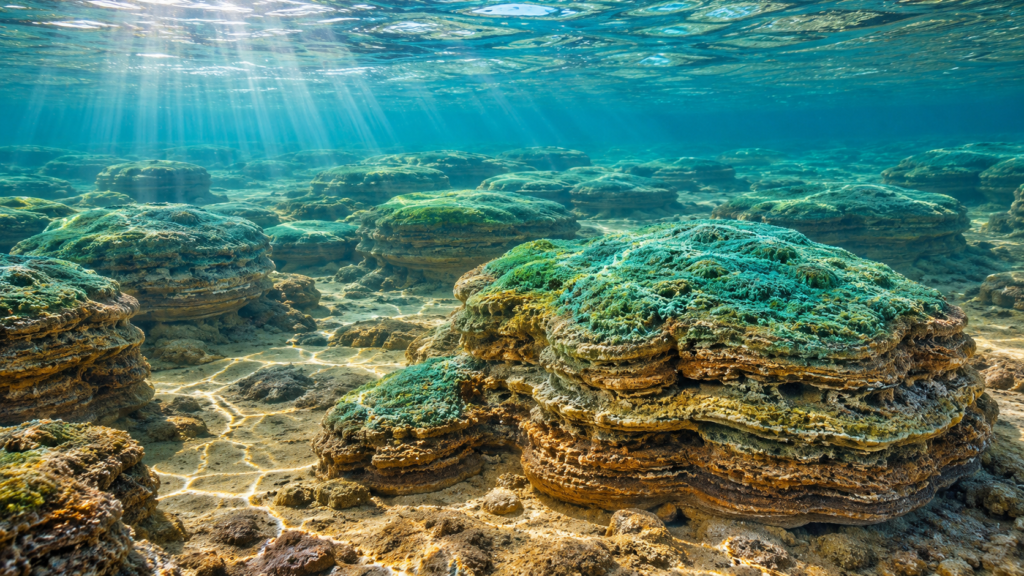
Cyanobacteria can form layered microbial communities. In shallow water, sticky mats of microorganisms trap sediment and encourage minerals to accumulate. Over time, these layers can build structures called stromatolites. Fossil stromatolites are among the most recognizable traces of ancient microbial life, although not every stromatolite proves that its builders were oxygen-producing cyanobacteria. The interpretation depends on age, geological setting and supporting chemical evidence.
In this article
- A planet before the oxygen we know
- The microscopic organisms that changed the planet
- Why oxygen did not build up straight away
- How do scientists know oxygen rose 2.4 billion years ago?
- What happened to the iron in the ancient oceans?
- Oxygen production: a biological process with planetary consequences
- A changing atmosphere—and a changing climate
- Did oxygen cause a mass extinction?
- Why the Great Oxidation Event did not create today’s atmosphere
- Why the event matters for the evolution of complex life
- The Great Oxidation Event is still being rewritten
- A world transformed by invisible life
An important scientific distinction is that the evolution of oxygen-producing photosynthesis and the Great Oxidation Event were not necessarily the same moment. Evidence suggests that oxygenic photosynthesis existed before atmospheric oxygen rose permanently. Some researchers infer that oxygen production may have begun hundreds of millions of years earlier, perhaps more than a billion years before the GOE, although the exact timing remains an active area of research.
Why would oxygen-producing organisms exist without immediately oxygenating the atmosphere? Because producing oxygen is not the same as allowing it to accumulate. Newly released oxygen can react with dissolved iron, volcanic gases, reduced minerals and organic matter. If these sinks consume oxygen as quickly as photosynthetic organisms produce it, the atmosphere can remain almost oxygen-free.
Why oxygen did not build up straight away
For a long time, Earth’s surface acted like a vast chemical sponge. Oxygen reacted with substances that had accumulated in an oxygen-poor world. Dissolved iron in the oceans was one important sink. Reduced volcanic gases and minerals exposed at the surface also consumed oxygen. Organic matter could be broken down and its carbon returned to the environment, using up oxygen in the process.
A lasting rise in atmospheric oxygen required a change in the global balance. One important process is the burial of organic carbon. When photosynthetic organisms make organic matter, oxygen is released. If that organic matter is later buried in sediments rather than fully decomposed, some of the reduced carbon is kept out of contact with oxygen. Over long periods, this can allow oxygen to accumulate. The real Earth system is more complicated, involving volcanic gases, nutrient supply, weathering, ocean chemistry and the recycling of carbon and nutrients.
The Great Oxidation Event therefore was not simply a case of bacteria suddenly becoming more productive. It reflects the interaction of life with geology. The supply of nutrients, the availability of shallow-water habitats, the chemistry of the continents and the rate at which oxygen was consumed all mattered. Scientists continue to investigate which processes were most important and how they changed through time.
How do scientists know oxygen rose 2.4 billion years ago?
No one watched the atmosphere change. There are no air samples from the early Proterozoic waiting in a laboratory. Instead, researchers read the chemical record preserved in ancient rocks. Different minerals form, survive or disappear under different chemical conditions. Isotopes—the different forms of an element—can also preserve clues about the atmosphere and oceans in which sediments formed.
One of the most important lines of evidence involves sulfur isotopes. In an atmosphere with extremely little oxygen, ultraviolet light can drive unusual sulfur isotope patterns that become preserved in rocks. These patterns are known as mass-independent fractionation. Their disappearance from the geological record around the GOE indicates that atmospheric chemistry had crossed a threshold associated with a rise in oxygen and the development of an ozone layer.
Other clues come from minerals that are easily altered by oxygen. Detrital grains of minerals such as pyrite and uraninite can survive transport and deposition in oxygen-poor conditions, but they are readily oxidized in oxygen-rich environments. Their disappearance from younger sediments is consistent with a more oxidizing atmosphere. In contrast, red beds—sedimentary rocks colored by oxidized iron minerals—become more common after oxygen began to accumulate.
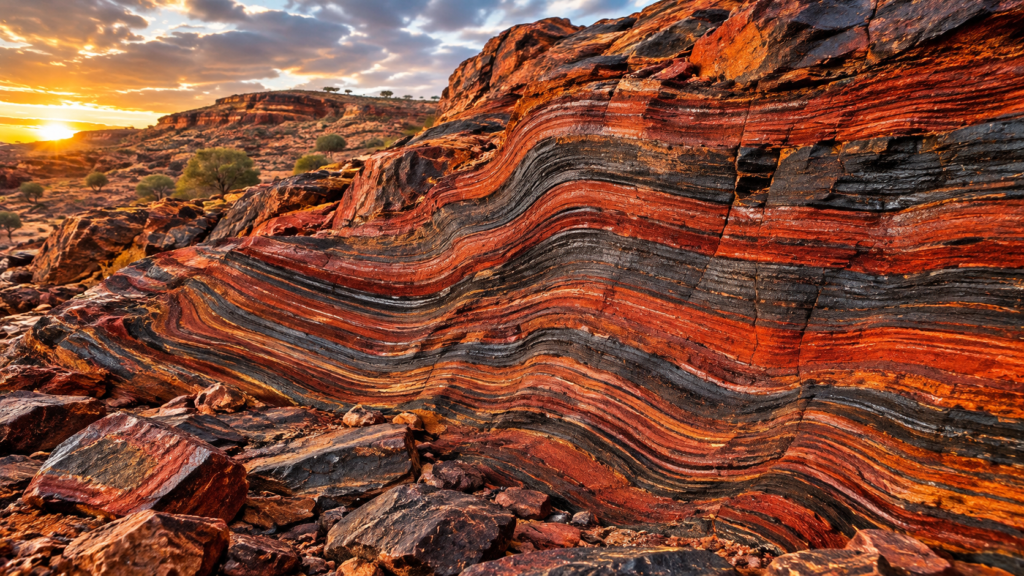
Banded iron formations provide another striking part of the record. These rocks contain alternating layers rich in iron minerals and silica. They formed in ancient marine environments and preserve information about the chemistry of seawater. Their distribution and changing abundance are linked to shifts in ocean chemistry, iron supply and oxygenation. They are not a simple meter that reads atmospheric oxygen directly, but they are an important piece of a much larger geological puzzle.
No single rock type tells the whole story. Scientists compare sulfur isotopes, iron formations, red beds, mineral grains, carbon isotopes and models of the atmosphere-ocean system. The strength of the case comes from the way independent lines of evidence fit together.
What happened to the iron in the ancient oceans?
In oxygen-poor seawater, iron could remain dissolved in its reduced ferrous form and travel through the ocean. When it encountered oxygen, it could be oxidized and precipitate as iron-rich minerals. This helps explain why iron-rich sedimentary deposits are associated with particular ancient marine settings and why their distribution changed as the chemistry of the ocean evolved.
The familiar banded appearance of these rocks comes from repeated changes in the material deposited on the seafloor. Their formation involved more than one process, and scientists continue to debate the relative roles of oxygen, hydrothermal inputs, microbial activity and changes in seawater chemistry. It would be inaccurate to claim that every banded iron formation was produced by one simple reaction or that all of them formed at exactly the same time as the atmospheric transition.
Oxygen production: a biological process with planetary consequences
Oxygenic photosynthesis uses a sophisticated protein complex to extract electrons from water. Splitting water releases oxygen, protons and electrons that help power the chemistry of photosynthesis. The process is carried out by cyanobacteria and, much later in evolutionary history, by algae and plants whose photosynthetic machinery ultimately traces back to cyanobacterial ancestors.
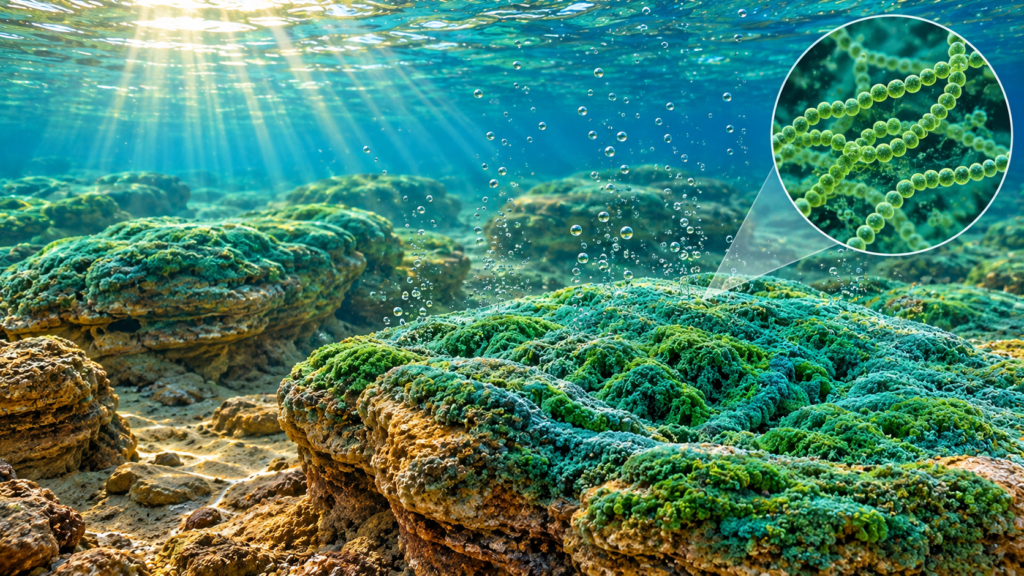
The first oxygen-producing organisms did not need to fill the sky to transform their surroundings. They could create small oxygen-rich zones around microbial mats, changing the chemistry of nearby water and sediments. Such local environments may have supported new chemical reactions long before the atmosphere as a whole became oxygenated.
The Great Oxidation Event marks a planetary-scale shift, not the first appearance of oxygen in every environment. The record suggests a complicated transition with fluctuations and regional differences. Some evidence points to earlier episodes of limited oxygenation, while other records indicate that the atmosphere and oceans did not become uniformly oxygen-rich at the same time.
A changing atmosphere—and a changing climate
The rise of oxygen affected more than respiration. Before the GOE, methane was likely an important greenhouse gas in the atmosphere. Oxygen reacts with methane, reducing its atmospheric lifetime. If methane concentrations fell significantly as oxygen accumulated, Earth’s ability to retain heat could have weakened. Some researchers link this chemical shift to major glaciations in the early Proterozoic, although the exact relationship among oxygen, methane, climate and ice ages remains an area of scientific investigation.
The atmosphere also gained the conditions needed to form a more effective ozone layer. Ozone in the upper atmosphere absorbs much of the Sun’s harmful ultraviolet radiation. Its development changed the radiation environment at Earth’s surface. The process was gradual and depended on atmospheric oxygen reaching a sufficient threshold; it was not an instant protective shield appearing overnight.
Did oxygen cause a mass extinction?
The rise of oxygen created opportunities for organisms that could use it, but it also posed a challenge to many forms of anaerobic life. Oxygen is highly reactive and can damage biological molecules. For organisms adapted to oxygen-free environments, the spread of oxygen into their habitats would have been disruptive. Some microbial communities may have retreated to oxygen-poor settings, while others evolved ways to tolerate or use oxygen.
It is tempting to describe the Great Oxidation Event as the first mass extinction, with oxygen as a poison that wiped out early life. That is too simple. The fossil and chemical record does not provide a straightforward global census of microbial populations before and after the event. Anaerobic organisms did not disappear; many lineages survive today in environments where oxygen is scarce or absent. The GOE changed the ecological playing field rather than ending anaerobic life.
Why the Great Oxidation Event did not create today’s atmosphere
A common misconception is that after the GOE, Earth quickly reached the oxygen level we breathe now. It did not. Atmospheric oxygen remained far below modern levels for a very long time, and the oceans were not uniformly oxygenated. The later rise toward modern oxygen levels involved additional stages in Earth’s history, including major changes hundreds of millions of years later.
The GOE is best understood as the first major permanent establishment of oxygen in the atmosphere, not the final step in oxygen’s history. Earth’s oxygen levels have changed over geological time. They have risen, stabilized and shifted again as biological productivity, organic carbon burial, weathering, volcanic emissions and ocean circulation changed.
Why the event matters for the evolution of complex life
Oxygen provides a powerful way for cells to release energy from food. Aerobic respiration can yield more usable energy from many organic molecules than fermentation or anaerobic pathways. That does not mean oxygen alone caused complex life to appear. Evolution depends on many interacting factors, and eukaryotic cells and multicellular organisms emerged through long, complex histories. But the expansion of oxygenated environments created new possibilities for metabolism and ecological complexity.
The GOE also changed the long-term relationship between life and the planet. Microorganisms altered the atmosphere; the new atmosphere changed which organisms could thrive; and evolving ecosystems influenced the chemistry of the oceans and sediments. Life was no longer merely adapting to Earth’s environment. It had become one of the forces reshaping the planet itself.
The Great Oxidation Event is still being rewritten
Scientists continue to refine the timing, magnitude and pace of oxygenation. New geochemical methods, better-dated rock sequences and updated models sometimes challenge the older picture of a single, sharp jump. A 2026 review in Communications Earth & Environment emphasizes that defensible estimates of atmospheric oxygen during the event still span a wide range, and that the detailed trajectory remains uncertain. This does not erase the event; it shows that the scale and rhythm of the transformation are still active research questions.
Other studies investigate how nutrient cycles may have helped oxygen accumulate. Research published in Nature Geoscience in 2022, for example, examined the role of sedimentary phosphorus recycling. Phosphorus is an essential nutrient for life, so changes in how it moved through sediments and seawater could have influenced biological productivity and the burial of organic carbon. No single explanation accounts for every part of the transition, and the best models combine biological and geological processes.
A world transformed by invisible life
The Great Oxidation Event is one of the most consequential turning points in Earth’s history because it changed the chemistry of the air, the oceans and the surface. It began with processes too small to see without a microscope: organisms capturing sunlight and releasing oxygen. Over immense spans of time, those biological processes interacted with rocks, minerals, oceans and the atmosphere until the planet itself began to change.
The story is not a simple tale of oxygen arriving and making everything better. Oxygen was a challenge for some organisms, a resource for others, and a force that altered climate and chemistry in ways that scientists are still working to understand. The atmosphere we take for granted today is the outcome of billions of years of interaction between life and the planet.
Every breath now depends on a history that began long before animals, forests or humans existed. The oxygen around us is not just part of the atmosphere. It is evidence of a planetary transformation driven by microscopic life—and preserved, patiently, in the rocks beneath our feet.
Explore more from TheOddNova
For another look at how Earth’s chemistry can create extraordinary natural events, read The Lake That Killed a Village Without Warning and explore 7 Natural Phenomena So Extreme They Seem Impossible.
Sources and further reading
- Lyons, Reinhard & Planavsky (2014), Nature — The rise of oxygen in Earth’s early ocean and atmosphere
- Alcott et al. (2022), Nature Geoscience — Earth’s Great Oxidation Event facilitated by the rise of sedimentary phosphorus recycling
- Nature Communications (2021) — The Great Oxidation Event as a consequence of ecological dynamics modulated by planetary change
- Ostrander, Johnson & Anbar (2021), Annual Review of Earth and Planetary Sciences — Earth’s First Redox Revolution
- Crockford et al. (2026), Communications Earth & Environment — Revisiting the greatness of Earth’s great oxidation