

Top 10 Ancient Mysteries That Still Baffle Scientists Today
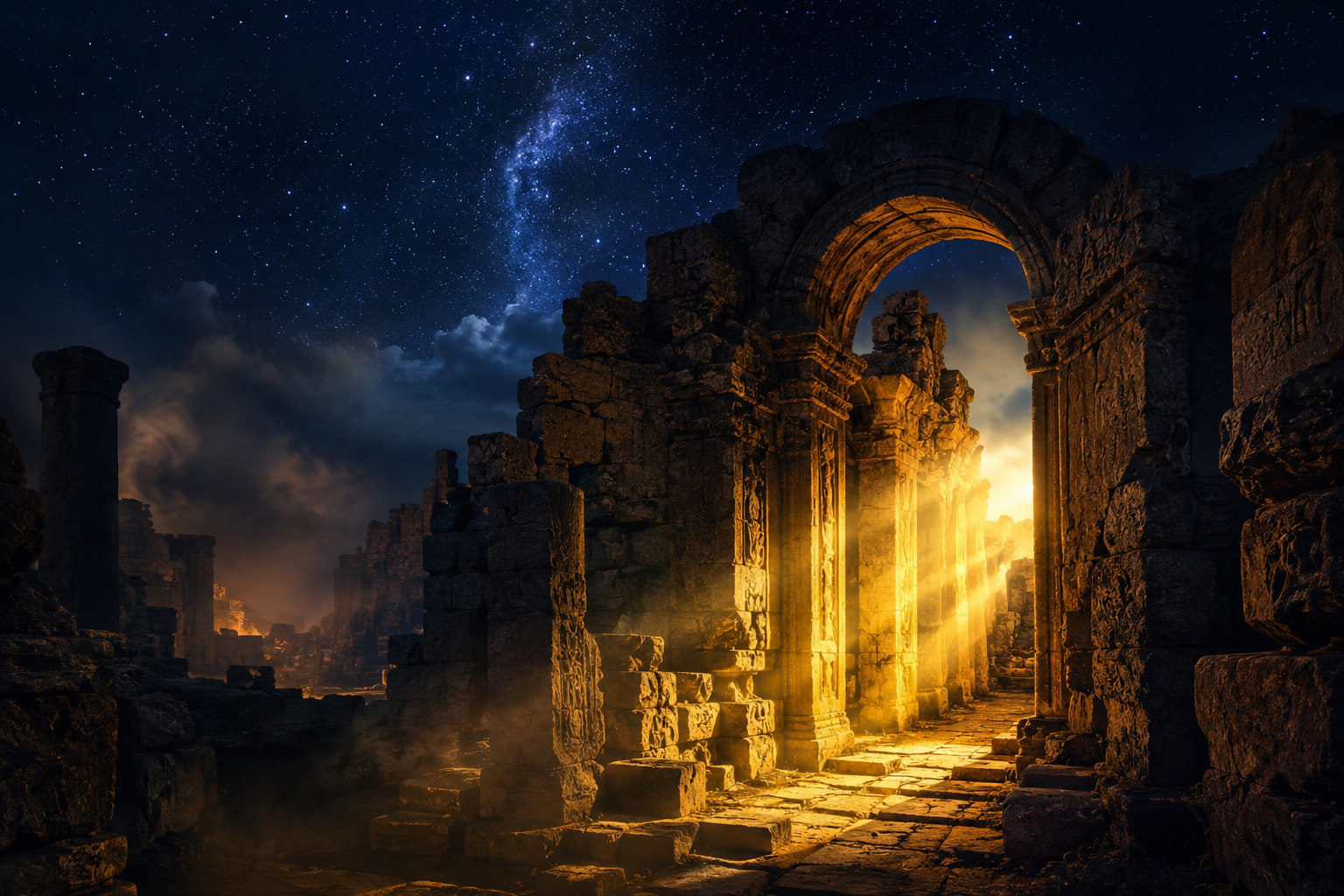
Long before satellites, computers, or modern engineering, ancient civilizations were already doing things we still struggle to explain. They moved stones heavier than a fully loaded jet. They built devices that predicted the movement of planets. They carved shapes into a desert floor so vast that no human eye on the ground could ever fully take them in.
It’s tempting to imagine the ancient world as simple, even primitive. But every so often, it hands us a puzzle that centuries of science still haven’t fully solved — not because these achievements were impossible, but because they reveal just how capable our ancestors truly were. Here are ten such puzzles, still standing today, still waiting for an ending.
1. Stonehenge’s True Purpose
On a quiet plain in southern England, dozens of massive stones rise out of the grass in a pattern too precise to be an accident. Some weigh over 25 tons. Others were dragged from quarries 150 miles away, using nothing but rope, timber, and human effort, sometime around 3000 BCE. The construction alone took nearly fifteen centuries, built and rebuilt across generations who never saw the finished monument.
Its design wasn’t guesswork, either. The stones align precisely with the sunrise on the summer solstice and the sunset on the winter solstice, meaning whoever built Stonehenge understood the sky well enough to freeze a single moment of the year in solid rock. Buried nearby are cremated remains and evidence of huge communal feasts, suggesting the site was part burial ground, part gathering place, part calendar.
What no one has settled is why. A tomb for the powerful? A place of healing? A symbol meant to unite scattered communities under one sky? Five thousand years later, the stones keep their answer to themselves.
2. The Baghdad Battery
In 1938, near a village outside Baghdad, archaeologists pulled a small clay jar from the ground — unremarkable, at first glance, barely five inches tall. Inside was something stranger: a copper cylinder wrapped around an iron rod, the two carefully kept apart by a layer of bitumen, like someone two thousand years ago had built the components of a battery without knowing the word for one.
Decades later, someone tested that theory literally. Fill a replica with vinegar or grape juice, and it produces a small electrical current. Not much — but enough to raise an uncomfortable question. Did an ancient craftsman stumble onto the basic principle of electricity, nearly two millennia before anyone officially gets credit for it?
Skeptics have a simpler answer: it may have just stored scrolls. No wires, no tools, nothing else electrical has ever turned up nearby to back the bolder theory. But nothing has ruled it out either — which is exactly why a five-inch jar of clay still makes historians argue.
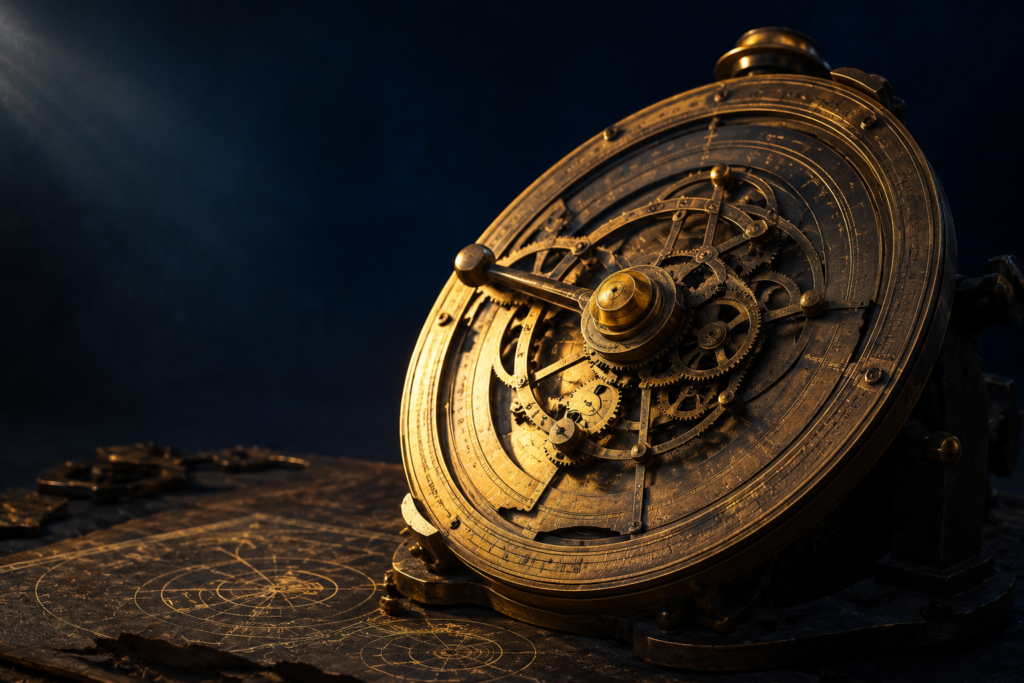
3. The Antikythera Mechanism
For decades, it sat in a museum drawer as a corroded, unimpressive lump of bronze — dragged up from a Roman shipwreck near a Greek island in 1901, and dismissed as scrap. Then came the X-rays.
Inside the corrosion were more than thirty gears, meshed together with a precision that shouldn’t have existed in 100 BCE. This wasn’t debris. It was a machine — one built to track the phases of the Moon, predict solar and lunar eclipses, estimate the positions of the known planets, and even calculate the schedule of the Olympic Games. Historians now call it the world’s first known mechanical computer.
The real mystery isn’t what it did. It’s that nothing else like it has ever been found. Technology this advanced simply vanishes from the historical record for over a thousand years after the fall of the classical world. Was this a singular genius’s one-of-a-kind invention — or the last surviving piece of an entire lost industry?
4. The Nazca Lines
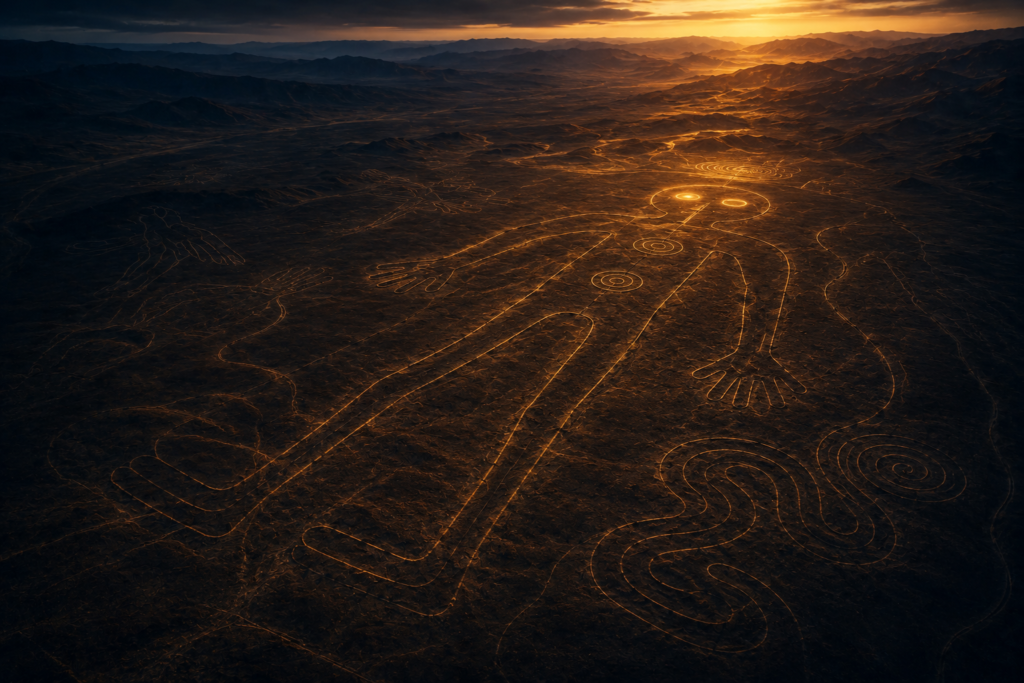
In the deserts of southern Peru, something strange is drawn across nearly 450 square kilometers of dry earth: a hummingbird stretched over a hundred feet wide, a spider, a monkey with a spiraled tail, lines running arrow-straight for miles. Created between roughly 500 BCE and 500 CE, the Nazca people made them simply by clearing away the dark, sun-baked stones on the surface, revealing the pale soil underneath — a method so light-touch it’s kept these images intact for two thousand years.
Drawing them wasn’t the hard part. Archaeologists have shown wooden stakes and rope were likely enough to plot the shapes with precision. The real puzzle is that many of these figures are too large to be recognized from the ground at all — they only resolve into hummingbirds and monkeys from high above, in a civilization with no aircraft, no drones, no way to check its own work from the sky.
Water rituals, fertility symbols, sacred pathways for ceremony — the theories are reasonable, and none of them are proven. The lines remain exactly what they were built to be: visible, immense, and silent about their own purpose.
5. The Great Pyramid’s Construction
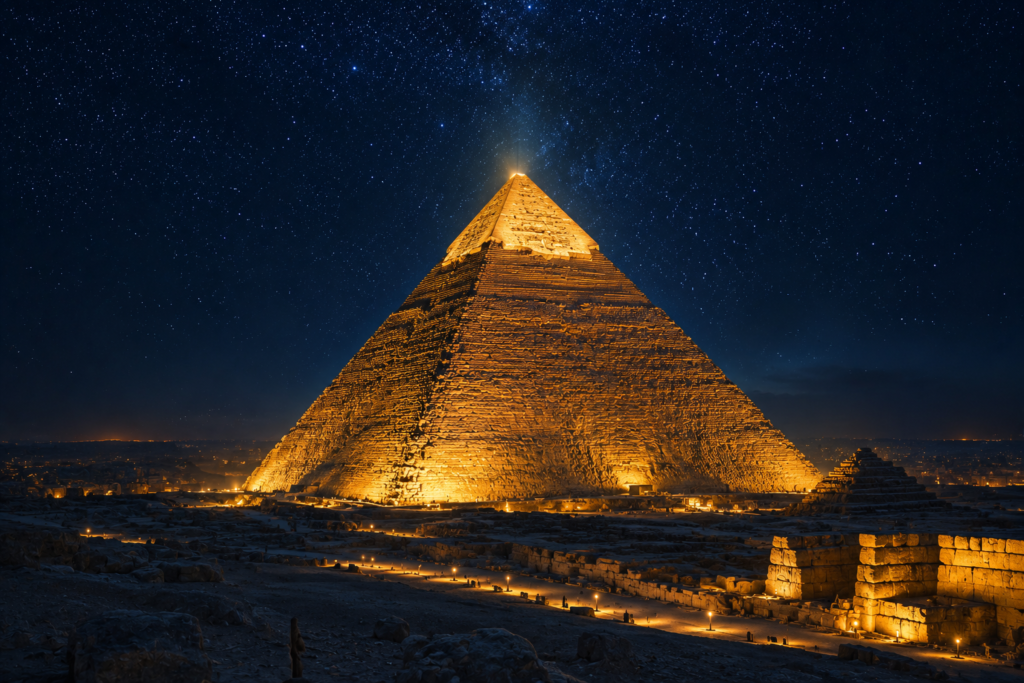
Outside modern Cairo stands the last of the Seven Wonders of the Ancient World still intact — 2.3 million blocks of stone, some weighing as much as 80 tons, stacked into a structure that held the record for the tallest building on Earth for almost four thousand years. It was raised around 2560 BCE, under Pharaoh Khufu, without iron tools, without the wheel as we use it, without a single crane.
Modern archaeology has filled in much of the picture: organized crews of skilled workers, not slaves; quarry sites and transport sledges; ramps engineered to haul stone into place. What still divides experts is the exact combination — which ramps, which lifting methods, how blocks weighing tens of tons were placed with such uncanny accuracy that the pyramid’s sides align almost perfectly with true north.
It wasn’t only an engineering feat. Every chamber and passage was built to carry the pharaoh into the afterlife, a physical monument to a belief system as carefully constructed as the stone itself. The mystery here isn’t that the builders lacked the ability — it’s that we’re still working out exactly how far that ability really went.
6. Puma Punku’s Precision Stonework
Nearly 13,000 feet up in the Bolivian Andes, air alone makes ordinary labor exhausting — and yet someone built this. The ruins of Puma Punku are scattered with andesite blocks cut so precisely that their flat faces, sharp right angles, and interlocking grooves look almost machine-milled. More than one visitor has assumed, wrongly, that modern tools were involved.
They weren’t. Archaeologists believe the Tiwanaku people achieved this through repetition rather than machinery — stone hammers, abrasive sand, careful measurement, and the kind of patience that doesn’t survive in most historical records. Moving the largest blocks, some over a hundred tons, across that terrain and altitude would have demanded coordinated labor on a scale that’s hard to picture today.
Much of the original structure collapsed long before archaeologists arrived, so no one is entirely sure how the pieces once fit together. What’s left is a scattered, half-solved puzzle — precise enough to look impossible, and old enough that no one alive watched it get built.
7. The Voynich Manuscript
Not every mystery on this list is made of stone. This one is bound in leather, kept behind glass at Yale University, and written in a script no living person can read.
Radiocarbon dating places the Voynich Manuscript in the early 1400s. Its roughly 240 pages are filled with fluid, confident handwriting, alongside illustrations of plants that match no known species, strange circular star charts, and figures that resemble nothing else from the period. Whoever wrote it clearly knew exactly what they were writing — the text follows patterns strikingly similar to real language, with word frequencies and structures that don’t look random.
Cryptographers who cracked Nazi codes have tried and failed. So have linguists, historians, and, more recently, artificial intelligence trained to detect hidden patterns. Is it a lost language? An elaborate cipher hiding real knowledge? An extraordinarily convincing hoax? Six hundred years later, the manuscript still isn’t telling.
8. Easter Island’s Moai Statues
More than 2,000 miles from the nearest continent, on one of the most isolated islands on Earth, nearly 900 stone figures stare inland with the same unreadable expression. The Moai of Rapa Nui, carved between roughly 1250 and 1500 CE, were cut from volcanic ash at a single quarry and then, somehow, distributed across the island — some over 30 feet tall, weighing more than 80 tons.
For years, the obvious question had no obvious answer: how do you move statues that heavy, that far, with no wheels and no draft animals? Local legend insisted the Moai simply walked. Modern researchers, testing that story instead of dismissing it, found that upright statues really can be “walked” forward by teams rocking them side to side with ropes — a discovery that turned an old myth into a working theory.
What the statues meant is less disputed. Positioned facing their villages, they’re widely believed to represent watchful ancestors, a stone bridge between the living and the dead. How, exactly, they got where they stand — and how it was all coordinated across an entire island society — is still being pieced together.
9. The Underwater Ruins of Dwarka
Off the coast of Gujarat, India, divers have mapped something unexpected on the floor of the Arabian Sea: geometric stone formations, walls, and structures that shouldn’t be underwater at all — unless, at some point, they weren’t.
Ancient Hindu texts describe Dwarka as a magnificent coastal kingdom ruled by Krishna, ultimately swallowed by the sea after his death. When marine archaeologists began pulling up pottery, anchors, and cut stone from the seabed nearby, the legend suddenly looked less like myth and more like a memory of something real.
Not everyone agrees on what they’ve found. Some researchers see clear evidence of human construction; others suspect natural rock formations shaped by centuries of erosion. What’s harder to dispute is the bigger picture: coastlines shift, sea levels rise, and entire settlements that once stood in the open air can end up resting quietly on the ocean floor, waiting for someone with a diving mask to notice.
10. Baalbek’s Impossible Stones
In Lebanon’s Bekaa Valley, beneath the columns of a Roman temple, sit stones that shouldn’t have been movable by anyone in the ancient world — and yet clearly were. The largest of the Trilithon blocks weighs roughly 800 tons. Nearby, still sitting in the quarry where it was cut, lies an unfinished block known as the Stone of the Pregnant Woman: nearly 1,650 tons of solid limestone that never made it to its final destination.
Roman engineers were extraordinarily capable — their roads, aqueducts, and bridges still stand across three continents. But moving and precisely placing single stones heavier than a modern airliner would have demanded a level of planning, manpower, and mechanical ingenuity that no surviving Roman text fully describes. Historians point to wooden rollers, sledges, ramps, and thousands of coordinated laborers as the likely answer — a reasonable explanation that still leaves the finer details unresolved.
Nothing about Baalbek requires lost technology or forgotten magic to explain it. It requires only the uncomfortable admission that people two thousand years ago solved engineering problems we’d still find difficult today.
Final Thoughts
Look at these ten mysteries side by side, and a pattern starts to emerge that has nothing to do with stone or bronze. Civilizations that never met, separated by oceans and centuries, kept reaching for the same impossible standard — building something too precise, too massive, or too advanced to feel like it belonged to its own era.
Modern science has explained a remarkable amount about how these places came to exist. What it hasn’t fully explained is why people kept trying, generation after generation, to build things just beyond the edge of what seemed possible. Maybe that’s the real mystery worth solving.
Read also
📖 50 Amazing Facts About the Human Body You Never Knew
📖 50 Amazing Facts About Space and the Universe
📖 35 Deep Sea Creatures That Look Like Alien Monsters
📖 7 Unexplained Mysteries That Continue to Puzzle Experts Today