

50 Amazing Facts About Space and the Universe
Look up on a clear night, and you’re not just looking at lights in the sky — you’re looking back in time. Some of that starlight left its source before humans had invented writing. The universe you’re glimpsing isn’t calm and empty; it’s violent, strange, and almost incomprehensibly vast, and we’ve only begun to understand the smallest fraction of it.
Here are 50 facts that reveal just how bizarre, beautiful, and humbling the universe really is.
Our Solar System
Before we go far, it’s worth remembering how strange our own neighborhood already is.
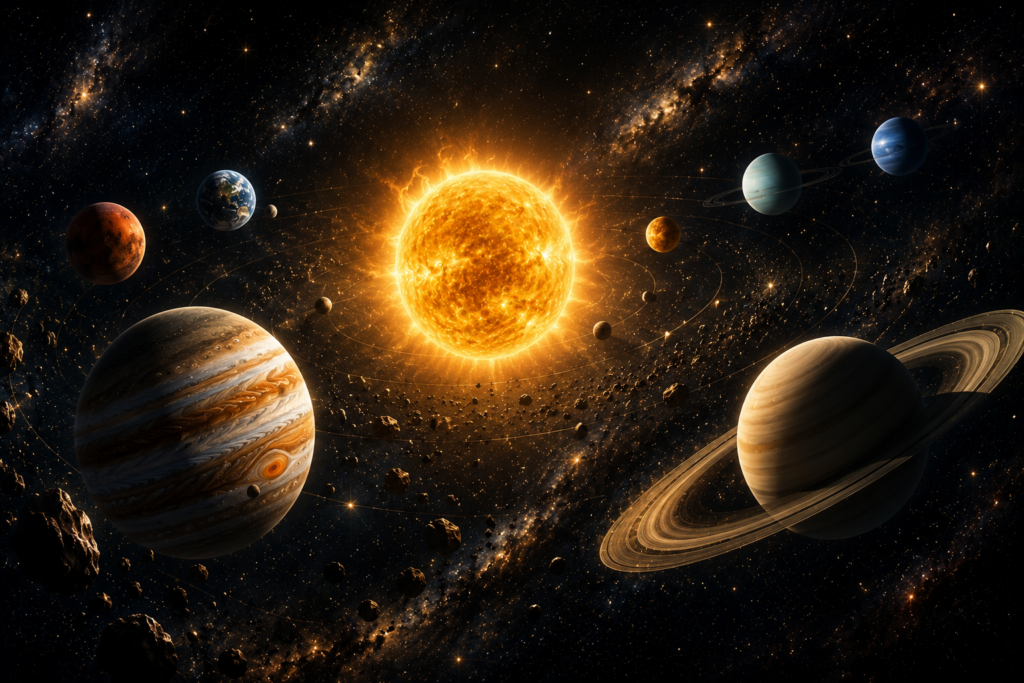
- The Sun accounts for about 99.86% of all the mass in our entire solar system — the planets, moons, and everything else make up a mere sliver of the rest.
- A day on Venus is longer than its year. It takes Venus about 243 Earth days to rotate once, but only 225 Earth days to orbit the Sun.
- Jupiter’s Great Red Spot is a storm larger than Earth itself, and it has been raging for at least 350 years.
- Saturn’s rings are made almost entirely of ice and rock, and in places they’re only about 30 feet thick, despite spanning hundreds of thousands of miles across.
- Mars is home to the largest volcano in the solar system, Olympus Mons, which stands nearly three times taller than Mount Everest.
- If you could find a bathtub big enough, Saturn would float — it’s the only planet in our solar system less dense than water.
- One million Earths could fit inside the Sun, and even then, there would be room to spare.
Stars and Galaxies
Zoom out past our solar system, and the numbers stop feeling real.
- There are more stars in the observable universe than grains of sand on every beach on Earth combined.
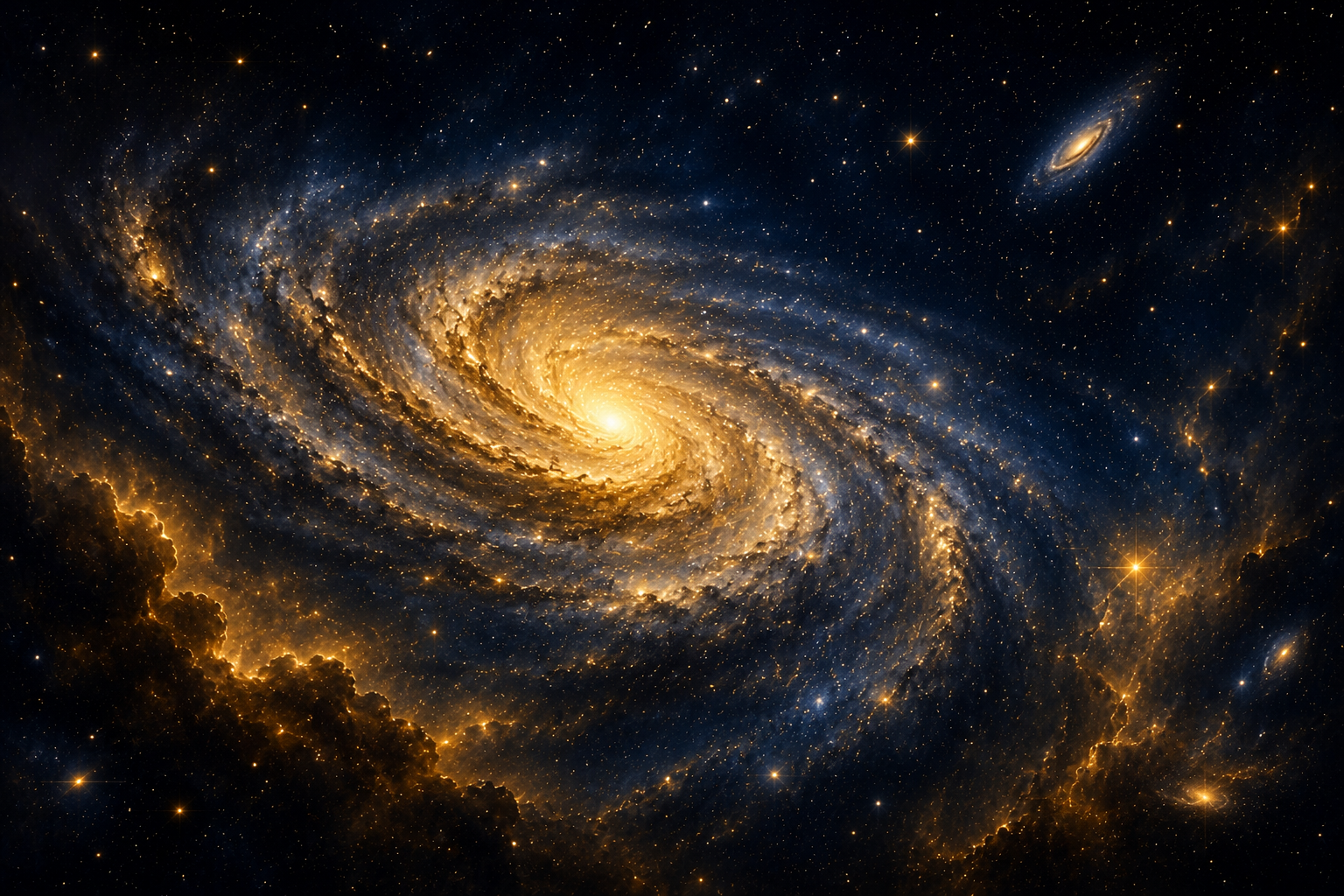
- Our galaxy, the Milky Way, contains an estimated 100 to 400 billion stars — and it’s just one of an estimated two trillion galaxies in the observable universe.
- The Milky Way isn’t standing still. It’s on a slow collision course with the Andromeda galaxy, expected to merge with us in about 4.5 billion years.
- Some stars are so massive that if placed where our Sun is, their surface would extend past the orbit of Jupiter.
- A single teaspoon of material from a neutron star would weigh about a billion tons on Earth.
- Light from the nearest major galaxy, Andromeda, takes about 2.5 million years to reach us — meaning we’re seeing it as it looked long before modern humans existed.
- Not all stars shine steadily. Some, called pulsars, spin hundreds of times per second, sweeping beams of radiation across space like a cosmic lighthouse.
Black Holes and the Fabric of Time
Few objects challenge human intuition as thoroughly as black holes.
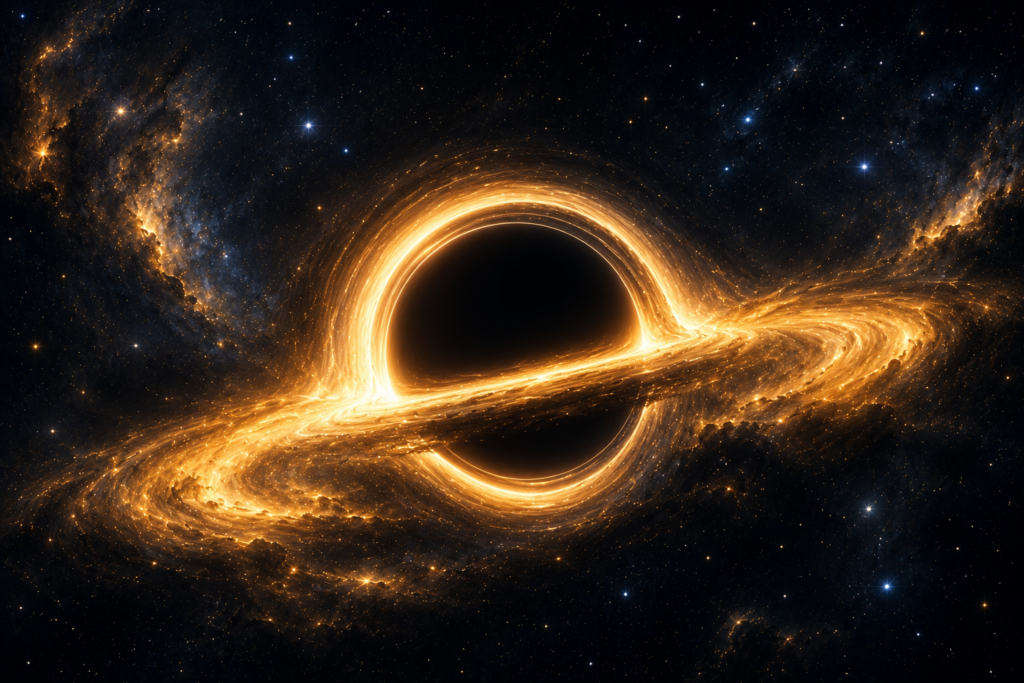
- A black hole isn’t really a hole at all — it’s an incredibly dense concentration of mass with gravity so strong that not even light can escape it.
- At the center of the Milky Way sits a supermassive black hole called Sagittarius A*, with a mass roughly four million times that of our Sun.
- Time itself moves slower near a black hole. An astronaut hovering close enough would age noticeably slower than someone watching from a safe distance — a real effect predicted by Einstein’s theory of relativity.
- The first-ever photograph of a black hole wasn’t captured until 2019, despite scientists theorizing their existence for over a century.
- If you fell into a black hole, an outside observer would never actually see you cross the edge — you’d appear to freeze in place, fading from view forever.
- Scientists believe most large galaxies, including our own, have a supermassive black hole quietly anchoring their center.
Space Exploration and the Human Story
For all its vastness, the universe has a surprisingly human side — the story of a species trying to understand its place in it.
- The footprints left by Apollo astronauts on the Moon are expected to last for millions of years, since there’s no wind or water there to erode them.
- The International Space Station travels at roughly 17,500 miles per hour, circling the Earth about every 90 minutes — meaning astronauts on board see a sunrise or sunset roughly every 45 minutes.
- Voyager 1, launched in 1977, is now the most distant human-made object from Earth, and it’s still transmitting data from interstellar space.
- Space itself is completely silent, because sound needs a medium like air to travel — a vacuum can’t carry it at all.
- In microgravity, astronauts’ spines stretch out because there’s no gravity compressing them, meaning many return to Earth up to two inches taller, at least temporarily.
- It took less time to travel from Earth to the Moon during the Apollo missions than it currently takes to drive across some of the largest countries on Earth.
- A full NASA spacesuit costs more than $12 million, largely due to the complex life-support systems it has to carry.
Strange and Surprising Facts
The universe saves some of its strangest secrets for the details.
- Space is not completely empty — even the emptiest regions still contain a few atoms per cubic meter, technically making a perfect vacuum impossible.
- If two pieces of the same type of metal touch in the vacuum of space, they can fuse together permanently, a phenomenon called cold welding.
- A day on Earth is very gradually getting longer, as the Moon’s gravity slowly slows our planet’s rotation by about 1.7 milliseconds per century.
- There’s a planet-like object called 55 Cancri e that may be covered in a layer of diamond, formed under extreme heat and pressure.
- The largest known structure in the universe, a vast collection of galaxies called the Hercules–Corona Borealis Great Wall, is so large that light would take about 10 billion years to cross it.
- Neutron stars can spin so fast that their surface moves at a significant fraction of the speed of light.
- Because light takes time to travel, looking deep into space is the closest thing humans have to genuine time travel — some of the light reaching our telescopes today began its journey before Earth even existed.
- The coldest known place in the universe isn’t in deep space at all — it’s a laboratory-created state on Earth, colder than the natural background of space itself.
- Saturn isn’t the only ringed planet. Jupiter, Uranus, and Neptune all have rings too, though far fainter and harder to see.
- Our solar system is moving through the Milky Way at roughly 450,000 miles per hour, and the entire galaxy itself is moving through the universe even faster.
- There may be more potentially habitable planets in the universe than there are grains of sand on every beach and desert on Earth combined.
- A year on Neptune lasts about 165 Earth years — meaning it has only completed one full orbit since its discovery in 1846.
- The Moon is very gradually drifting away from Earth, moving about 1.5 inches farther every year.
The Universe’s Deepest Mysteries
And then there are the questions that remain almost entirely unanswered.
- Roughly 68% of the universe is believed to be made of dark energy, and another 27% is dark matter — meaning the stars, planets, and everything visible to us makes up less than 5% of everything that exists.
- Scientists still don’t know what dark matter or dark energy actually are, only that their effects can be measured through gravity and cosmic expansion.
- The universe isn’t just expanding — it’s expanding at an accelerating rate, a discovery that stunned astronomers when it was confirmed in the late 1990s.
- It’s estimated the observable universe spans about 93 billion light-years across, yet that may be only a small fraction of the universe as a whole.
- Some scientists theorize there could be multiple universes beyond our own, though the idea remains firmly in the realm of theoretical physics.
- The night sky we see is a patchwork of different times — some starlight is a few years old, some is millions, and some is billions, all arriving at your eyes in the same instant.
- Despite decades of searching, humanity has yet to find confirmed evidence of life anywhere beyond Earth.
- The universe is estimated to be about 13.8 billion years old, calculated by studying the faint afterglow of the Big Bang still detectable throughout space today.
- Everything on Earth, including the atoms in your own body, was originally forged inside the cores of ancient, long-dead stars.
- As vast and strange as it is, everything astronomers have observed may represent only a tiny visible fraction of a universe whose true scale we may never fully comprehend.
Final Thoughts
It’s easy to feel small standing beneath a night sky this vast — and in a very real sense, you are. But there’s something quietly remarkable in that smallness, too. The same physics that built galaxies and bent the light of dying stars also built the atoms in your hands, your eyes, the thought forming in your mind right now.
The universe isn’t just something you look up at. In the most literal sense, it’s something you’re made of.
Read Also →
📖 50 Amazing Facts About the Human Body You Never Knew
📖 Top 10 Ancient Mysteries That Still Baffle Scientists
📖 35 Deep Sea Creatures That Look Like Alien Monsters
📖 7 Unexplained Mysteries That Continue to Puzzle Experts Today
📖 7 Animlals Scientists Thought Were Extinct — Until Now
The Planet Where It Rains Glass Sideways: The Most Extreme World Ever Discovered