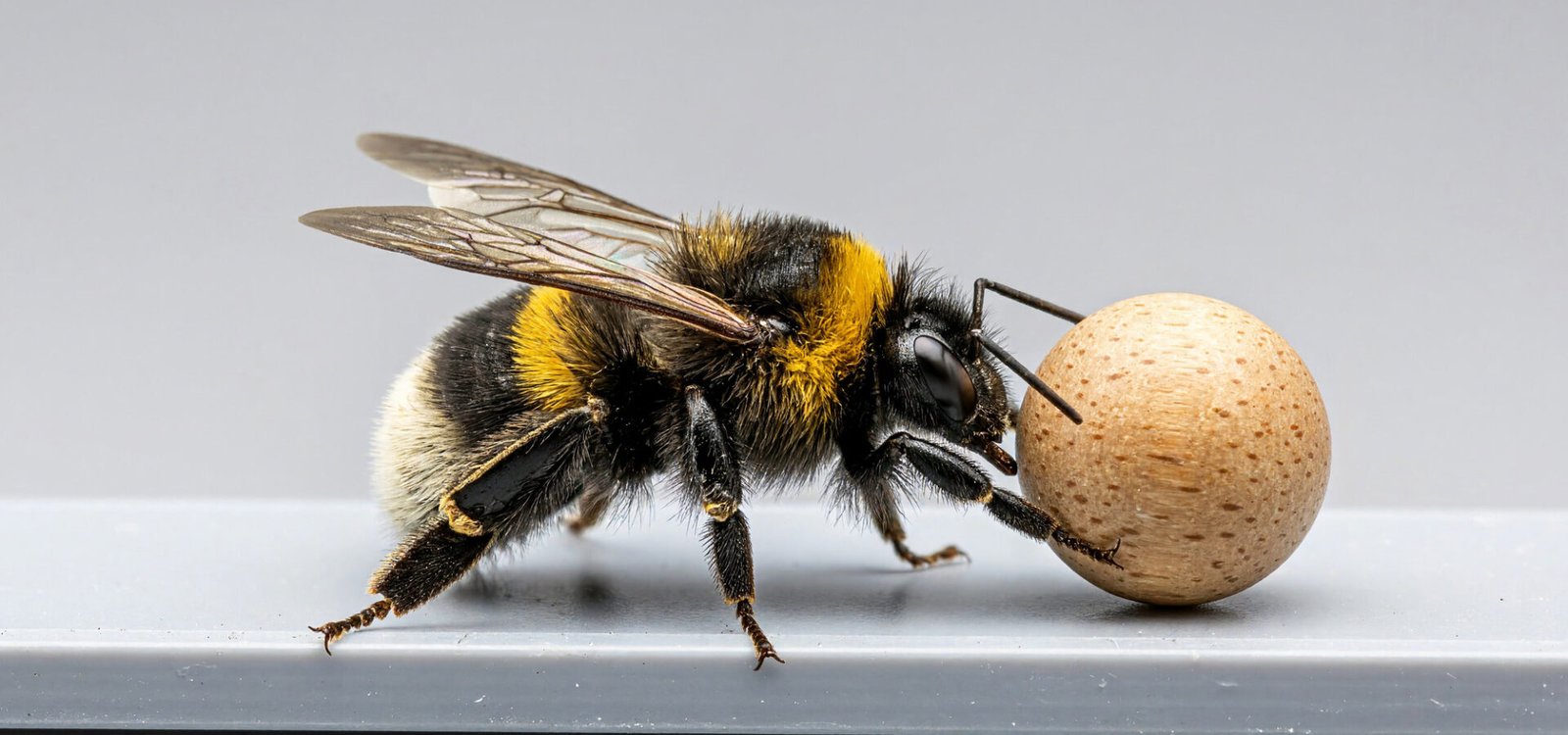
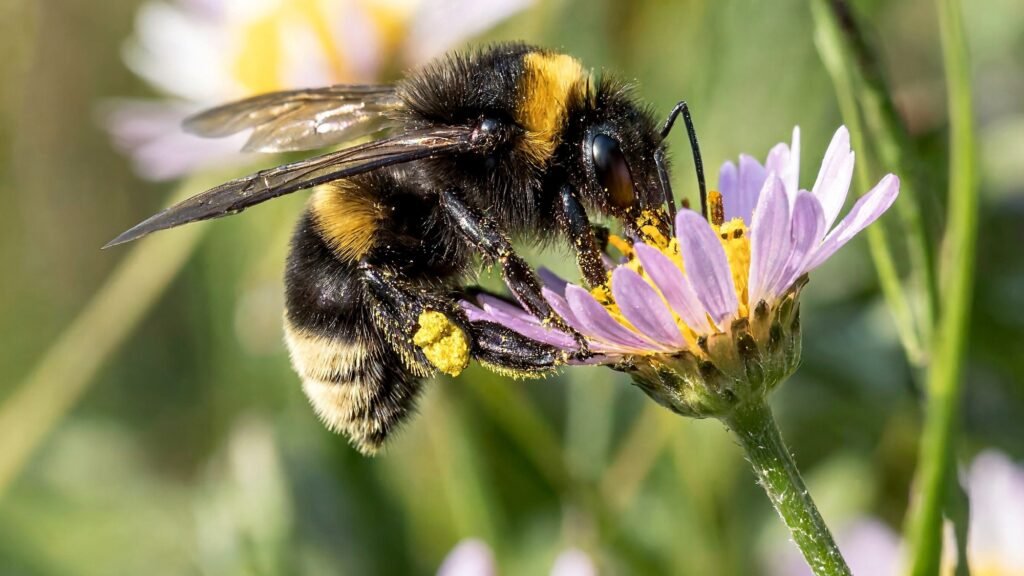
A bumblebee lands beside a small wooden ball. It does not collect nectar from it. It cannot eat it, carry it back to the nest, or use it to build anything. Yet the bee returns, grips the ball, and rolls it across the floor. Then it does something even more puzzling: it comes back and does it again.
To a human observer, the scene looks like a tiny game. But for a long time, the idea that an insect might play seemed almost impossible. Play is usually associated with young mammals, energetic birds, and animals with complex social lives. Insects, by contrast, were often described as creatures driven almost entirely by instinct.
A series of carefully designed experiments has begun to challenge that simple picture. Researchers found that buff-tailed bumblebees repeatedly rolled small wooden balls even when the activity brought no food reward. The bees appeared to seek out the experience itself.
The finding does not prove that a bee feels joy in the same way a person does. It does, however, raise a fascinating scientific question: if an animal with a brain far smaller than a grain of rice repeatedly chooses an activity that serves no obvious practical purpose, what might that tell us about the inner lives of insects?
A Strange Observation
The story began with a different experiment. Researchers had already discovered that bumblebees could learn to roll a ball toward a target in order to obtain a sugary reward. The task was designed to investigate how flexible bee learning could be. But while watching the insects, the team noticed something that did not fit neatly into the experiment.
Some bees rolled balls when no reward was available. They did it outside the trained task, and they sometimes went out of their way to reach the balls even when a clear route to food was available. The balls were not hiding nectar. They were not blocking the path. Rolling them did not open a door or help the bee reach a flower.
That observation inspired a new question. Were the bees simply exploring unfamiliar objects, or was the activity closer to play?
The distinction matters. Animals investigate new objects for many reasons. They may be searching for food, testing a possible nest material, clearing an obstacle, or learning whether something is dangerous. A single curious interaction is not enough to establish play. Researchers needed to test the behaviour systematically and rule out more ordinary explanations.
In 2022, a team led by Hiruni Samadi Galpayage Dona and colleagues published a study titled “Do bumble bees play?” in the journal Animal Behaviour. It examined whether ball rolling matched established scientific criteria used to identify play in animals.
What Scientists Mean by Play
In everyday language, play means doing something for fun. In science, the definition is more careful. Researchers cannot simply look at an animal and know what it feels. Instead, they study the structure and context of its behaviour.
A widely used framework for identifying play asks whether an action is voluntary, repeated, and not immediately necessary for survival. It should differ in some way from the animal’s ordinary functional behaviour. It should not be a fixed, repetitive pattern caused by stress. And it should occur when the animal is not under conditions that would make the behaviour an obvious response to hunger, fear, or another urgent need.
These criteria help researchers distinguish play from other activities that may look similar. A young animal practising a movement that will later help it hunt, for example, may be playing. But an animal repeatedly performing a rigid movement because its environment is stressful may be showing a stereotyped behaviour rather than play.
Even when an action meets the criteria, scientists usually describe it as play-like or as fulfilling behavioural criteria for play. That wording is important. It describes the evidence without pretending that researchers can directly measure an animal’s private experience.
Inside the Ball-Rolling Experiment
The 2022 study focused on buff-tailed bumblebees, Bombus terrestris. The researchers created an arena that connected the bees’ nest area with a feeding area. Wooden balls were placed in separate sections. Crucially, the bees had an unobstructed route to reach food without passing through the balls.
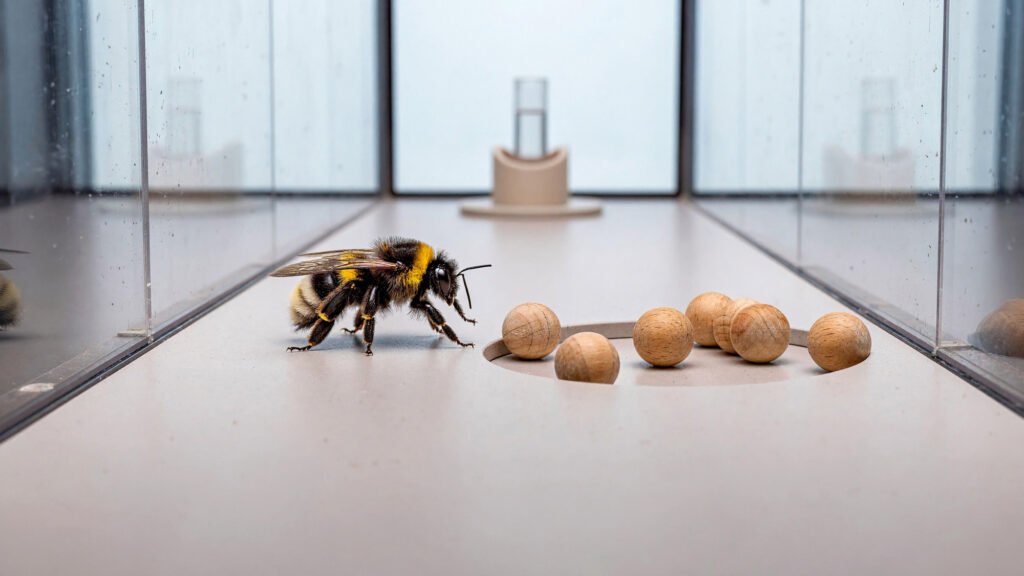
This gave the insects a choice. They could take the direct route to the food, or they could leave that route, enter an area containing balls, and interact with them. The balls were not food, and rolling them did not unlock a treat.
The researchers recorded 45 individual bees and documented 910 ball-rolling actions. Across the experiment, individual bees varied considerably: some rolled balls only a few times, while others rolled them repeatedly. The researchers reported that individual bees rolled balls between one and 117 times over the full observation period.
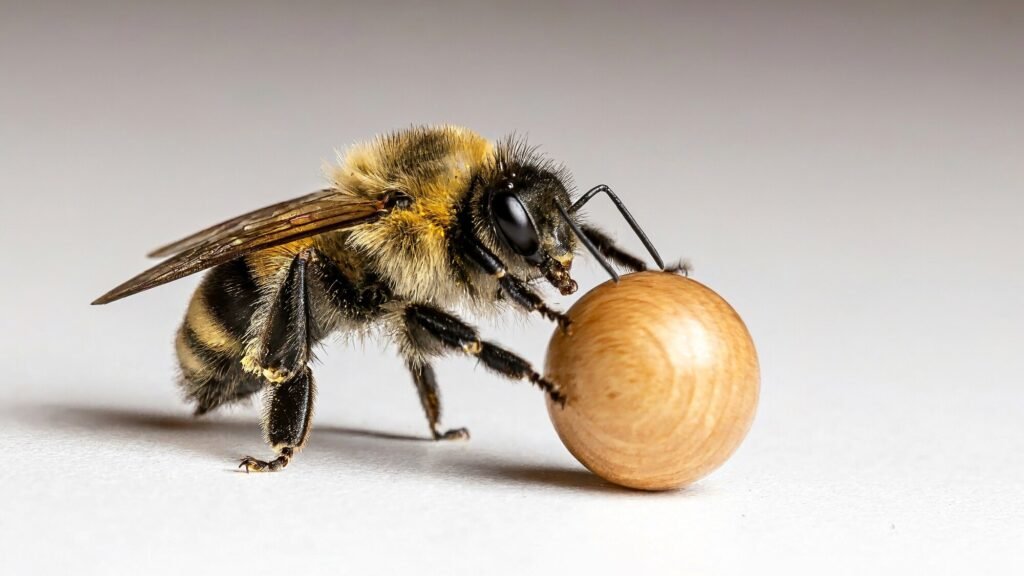
That variation was useful. It showed that the behaviour was not a single accidental contact repeated by every bee in the same way. Some individuals returned to the activity again and again, even after they had already visited the feeding area.
The team also compared movable balls with objects that could not be rolled. The bees’ behaviour suggested that the movement itself mattered. They were not simply attracted to any object placed in the arena.
Why Roll a Ball If There Is No Reward?
The first challenge was to find out whether the bees were rolling balls for some hidden practical reason. Perhaps the objects looked like food. Perhaps the insects were clearing clutter from a route. Perhaps they were practising a movement that helped them handle flowers.
The researchers designed the experiment to make these explanations less likely. The balls were not edible, the feeding route remained clear, and the activity did not provide access to nectar or pollen. The observed rolling also differed from the bees’ usual flower-handling movements.
The team considered mating as another possible explanation. But the behaviour did not fit the expected context or pattern of mating activity. The bees were not using the balls as partners, and the repeated rolling was not part of a reproductive interaction.
None of these controls can eliminate every imaginable alternative explanation. That is true of behavioural science generally. But together, they made the most straightforward practical explanations increasingly difficult to sustain.
The remaining possibility was striking: the bees might be engaging with the balls because the activity itself was rewarding. To test that idea, the researchers designed a second experiment that examined what the bees chose after experiencing ball rolling.
A Preference That Followed the Play
In another experiment, a separate group of 42 bumblebees had access to two differently coloured chambers. One chamber contained movable balls; the other did not. The bees could visit the areas and experience the ball-rolling opportunity.
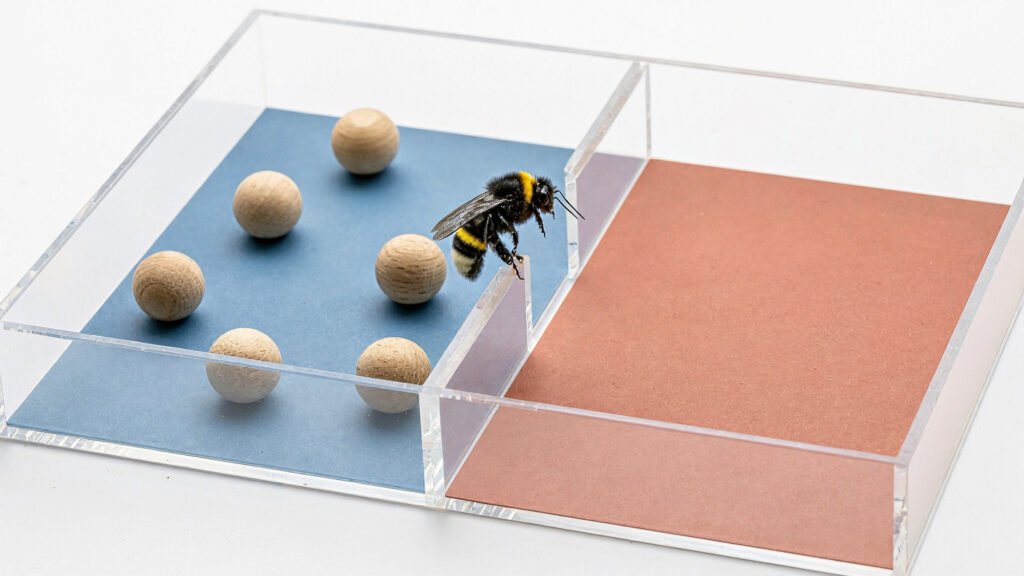
Later, the researchers tested the bees in a choice situation in which neither chamber contained balls. The question was whether the insects would show a preference for the colour associated with the earlier ball-rolling experience.
They did. The bees showed a preference for the chamber colour that had previously been paired with movable balls. In behavioural research, this kind of result can indicate that an experience has acquired positive value. The activity appeared to make the associated place more attractive, even when the balls themselves were no longer present.
This was an important part of the evidence. It suggested that the bees were not merely touching a novel object once and moving on. Their later choices were influenced by the opportunity to roll balls.
The result is consistent with the idea that ball rolling was intrinsically rewarding: the activity itself, rather than an external prize such as sugar water, seemed to matter. It still does not tell us exactly what the bee subjectively experienced. A preference test measures behaviour, not a verbal report of emotion.
The Young Bees and the Older Bees
The researchers also found differences linked to age. Younger bees rolled more balls than older bees. This pattern is interesting because play in many familiar animals is especially common during juvenile life. Young mammals often chase, wrestle, pounce, and manipulate objects more frequently than adults.
The comparison should not be taken too far. A bumblebee colony is not a miniature mammal society, and the life stages of insects do not map perfectly onto childhood and adulthood in humans. Still, the age pattern gave the researchers another point of comparison with play-like behaviour in vertebrates.
There were also differences between males and females. In the study, male bees rolled individual balls for longer durations than females. This does not mean that every male bee is more playful than every female, nor does it establish a universal rule for all bumblebee species. It describes a pattern observed in this particular experimental setting.
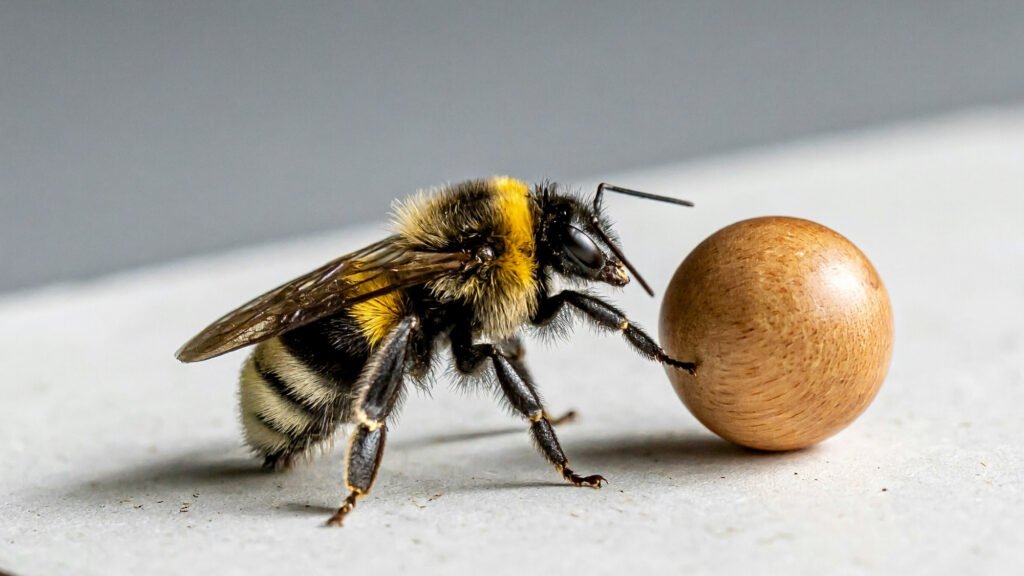
Age and sex differences matter because they suggest that ball rolling was not simply random movement. The behaviour varied in systematic ways across individuals. That kind of variation is one reason researchers considered it meaningful enough to investigate as possible play.
Five Clues That Point Toward Play
The authors assessed ball rolling against several recognised criteria for animal play. The behaviour did not appear to contribute to immediate survival, such as obtaining food or clearing a necessary route. It was voluntary: bees could reach the feeding area without rolling any balls. It appeared rewarding, as shown by the later preference for the chamber associated with the activity.
The rolling also differed from ordinary functional behaviour. The bees did not become progressively faster or more efficient at it in the way an animal might when practising a task to improve performance. Instead, the action varied in duration and distance. It was repeated, but not in one rigid, identical pattern.
Finally, the researchers took steps to reduce stress during the experiment. The bees had access to food, were not repeatedly handled during the observations, and were not isolated as part of the test. The researchers reported no signs that the activity was simply a response to an acute stressful situation.
Taken together, these observations supported the conclusion that ball rolling fulfilled behavioural criteria for play. The strength of the study lies not in one amusing video, but in the combination of repeated observations and experiments designed to test competing explanations.
What Later Research Revealed About Bumblebee Learning
The ball-rolling paper was not the end of the story. In 2024, a study published in Nature reported that bumblebees could socially learn a two-step puzzle-box task from trained demonstrators. The task required a bee to move one tab before it could move a second tab and reach a sugary reward.
The sequence was difficult to discover independently. In control experiments, untrained bees did not solve the complete task even after extended exposure. But when a trained demonstrator performed the sequence, some observer bees learned to do it. Five of 15 observer bees passed the study’s learning test, showing that a behaviour too difficult for them to discover alone could be acquired socially.
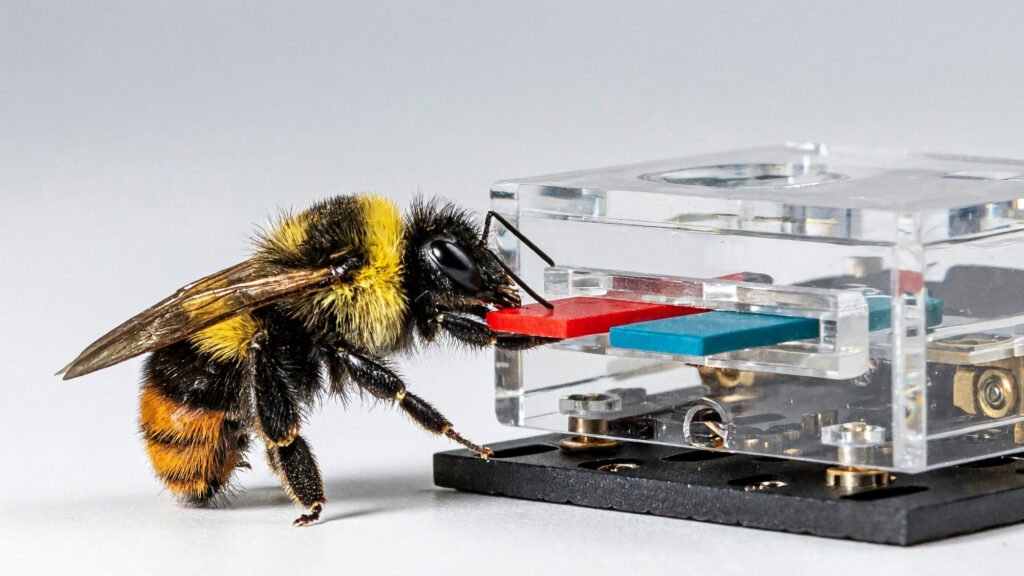
This was not a play experiment. It should not be presented as proof that the bees were playing with the puzzle box. Instead, it shows why the ball-rolling finding belongs to a broader scientific picture: bumblebees can learn in flexible ways, and their behaviour is more varied than simple reflex-based descriptions suggest.
In June 2026, another study in Science examined spontaneous problem-solving. Researchers reported that bumblebees could move a ball beneath a relocated target to reach a reward, including in control conditions designed to test whether the action was guided by the goal rather than by constant visual feedback. Again, this was a separate problem-solving task, not evidence of play. But it adds to the growing research on what these small insects can learn and do.
Does This Mean Bees Feel Happiness?
This is the question that makes the story so compelling — and the one that requires the most care. If a bee repeatedly chooses an activity that appears rewarding, is it experiencing something like enjoyment?
The experiments cannot answer that question in the same way a person could describe a feeling. Bees cannot tell researchers what the activity feels like. Scientists must infer possible internal states from patterns of behaviour, learning, and choice.
The ball-rolling study provides evidence consistent with a positive rewarding state. The bees returned to the activity, and their later preferences were influenced by the chamber in which they had rolled balls. Those are meaningful observations. They are not direct proof that a bee experiences happiness, amusement, or pleasure in a human-like way.
Researchers studying animal sentience often distinguish between evidence of flexible behaviour and evidence about subjective experience. The two are related, but they are not identical. A behaviour may indicate that an animal values an experience without revealing exactly how that experience feels.
The careful conclusion is therefore neither that bees are tiny humans nor that their behaviour is meaningless. The evidence supports taking insect experience seriously as a scientific question, while remaining honest about what has and has not been demonstrated.
The Important Limitation: Where Was the Play Observed?
There is another important boundary around the findings. The ball-rolling behaviour was studied in a controlled laboratory environment, using captive bumblebee colonies and an experimental arena. The researchers did not establish how often wild bumblebees roll objects in natural settings, or whether the same behaviour occurs regularly outside the laboratory.
That matters because animals behave differently depending on their surroundings. A laboratory can make a behaviour easier to observe and measure, but it can also create opportunities that do not exist in the wild. The authors themselves noted that future work should investigate whether play-like object manipulation occurs in natural environments and whether it has longer-term effects on the bees.
Scientists also do not yet know whether ball rolling helps bees develop skills, reduce stress, or improve later performance. Those are possible research questions, not established benefits. The study showed that the behaviour met several criteria for play and appeared rewarding under the conditions tested. It did not demonstrate that rolling balls makes bees better at finding flowers or surviving.
Being precise about these limits does not weaken the discovery. It makes the finding more useful. It tells us exactly what the experiment revealed — and what the next experiments need to investigate.
The Smallest Players May Change a Big Debate
A bumblebee rolling a wooden ball is an easy scene to underestimate. It is small, quiet, and almost comical. But the question behind it is much larger.
The research suggests that bumblebees may engage in a form of object play. They returned to movable balls without receiving food, and their later choices indicated that the experience had positive value. The pattern was not random enough to dismiss, and the experiments were designed to rule out several practical explanations.
What the study does not show is equally important. It does not prove that bees feel happiness exactly as humans do. It does not establish that wild bees play in the same way. And it does not reveal whether the behaviour improves survival or learning.
Instead, it opens a door. The more scientists study insects, the more they discover that small nervous systems can support surprisingly complex behaviour. A wooden ball may seem like an unlikely toy, but for researchers it has become a tool for asking one of biology’s most challenging questions: how far does the capacity for positive experience extend across the animal kingdom?
Perhaps the lesson is not that bees are more like us than we imagined. It is that the natural world is more varied — and more difficult to simplify — than we once believed.
Frequently Asked Questions
**Do bumblebees really play with balls?** A 2022 study found that buff-tailed bumblebees repeatedly rolled small wooden balls without receiving food rewards. The behaviour met several established behavioural criteria for animal play.
**Why did the bees roll the balls?** The experiments suggested that the activity itself was rewarding. The researchers ruled out several practical explanations, including food gathering and clearing a path. The exact subjective experience of the bees remains unknown.
**Did all the bees play equally?** No. Younger bees rolled more balls than older bees, and male bees rolled individual balls for longer than females in the study. These were patterns in the tested group, not rules that apply to every bumblebee.
**Does the study prove that bees feel happiness?** No. It provides evidence consistent with a rewarding positive experience, but it cannot directly prove what a bee subjectively feels or whether that feeling resembles human happiness.
**Do wild bumblebees roll balls in nature?** The study was conducted in a controlled laboratory setting. Researchers have called for further work to determine whether similar behaviour occurs in the wild.
**Are bumblebees intelligent?** Research shows that bumblebees can learn associations, solve certain problems, and acquire some behaviours socially. Their abilities are different from human intelligence, but they are more flexible than simple instinct-only descriptions suggest.
Sources & Further Reading
1. Galpayage Dona, H. S., Solvi, C., Kowalewska, A., Mäkelä, K., MaBouDi, H., & Chittka, L. (2022). “Do bumble bees play?” *Animal Behaviour*, 194, 239–251. https://doi.org/10.1016/j.anbehav.2022.08.013
2. Queen Mary University of London. (2022). “First-ever study shows bumble bees ‘play’.” Research summary
3. Bridges, A. D., et al. (2024). “Bumblebees socially learn behaviour too complex to innovate alone.” *Nature*, 627, 572–578. https://doi.org/10.1038/s41586-024-07126-4
4. Bhambore, A. A., et al. (2026). “Spontaneous problem-solving in bumble bees.” *Science*, 392(6802), 1046–1049. https://doi.org/10.1126/science.ady1618
Related Reading
Explore more stories about animal intelligence and surprising behaviour on TheOddNova: The Octopus That Learned to Use a Mirror and Do Elephants Have Names?.