Imagine entering a world with no roads, no street signs and no landmarks that stay still. The horizon looks the same in every direction. Currents carry you across distances too vast to see, and the place you left behind disappears almost immediately. Now imagine finding your way through that world—and, years later, returning to the same stretch of coastline where your journey began.
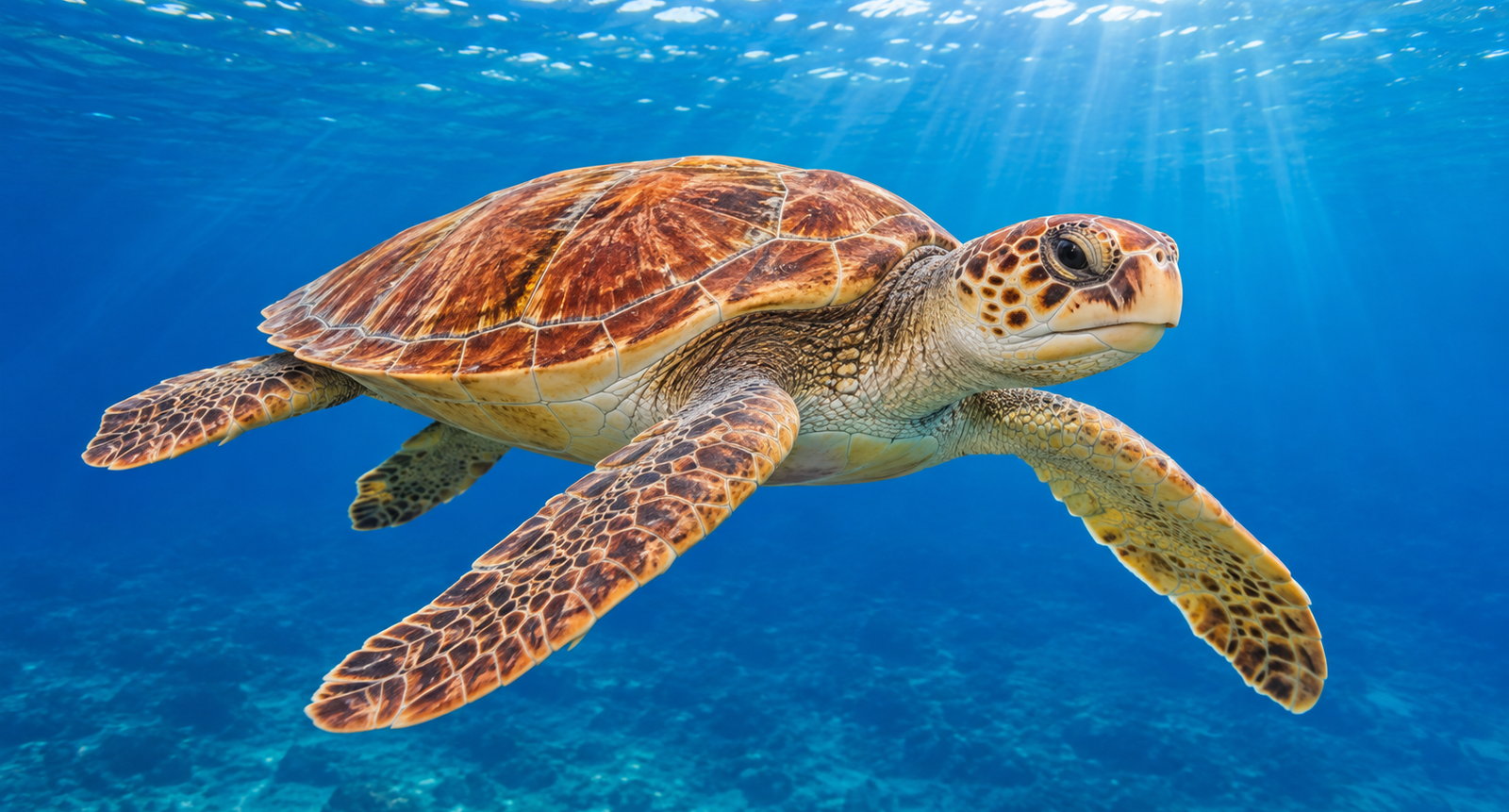
For a young sea turtle, this is not a fantasy. It is part of life. After hatching on a sandy beach, a loggerhead turtle may spend years travelling through the open ocean before moving toward coastal feeding grounds. As an adult, a female may migrate hundreds or even thousands of miles to nest in the general region where she hatched. The ocean seems empty, but to the turtle it contains clues that human eyes cannot see.
One of the most remarkable of those clues is Earth’s magnetic field. This is the secret at the heart of sea turtle magnetic navigation: the ability to use a force that humans cannot see to make sense of an immense ocean. Researchers have found that sea turtles can use magnetic information in ways that resemble both a compass and a map. And studies published in 2025 and 2026 have brought scientists closer to understanding how this hidden navigation system works.
The First Journey Begins in the Sand
A sea turtle’s journey starts before it ever touches the water. A female loggerhead comes ashore, usually under the cover of darkness, and lays her eggs in a nest dug into the sand. Weeks later, the hatchlings emerge and begin the urgent trip from the nest toward the sea.
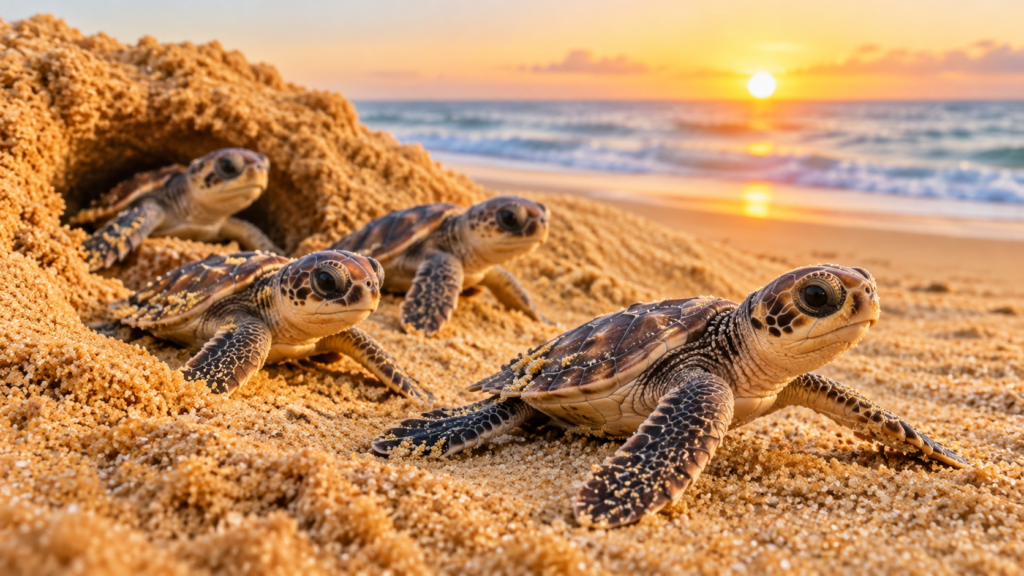
At this stage, the tiny turtles do not simply choose a direction at random. On a natural, undeveloped beach, they use visual features of the horizon to find the ocean. The darker outline of dunes and vegetation helps distinguish land from the brighter open horizon over the water. Once they reach the surf, the waves and their movement provide further directional information.
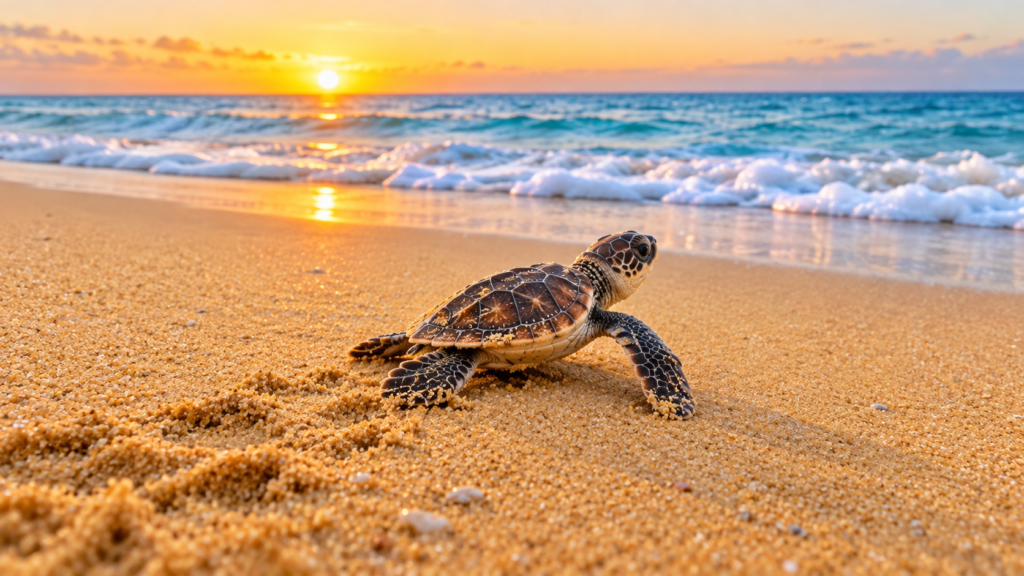
Artificial lighting can interfere with this first decision. Bright lights from buildings, roads or beachfront properties may draw hatchlings away from the ocean. This is one reason dark, undisturbed nesting beaches matter so much. The first few minutes of a turtle’s life outside the nest can influence whether it reaches the water at all.
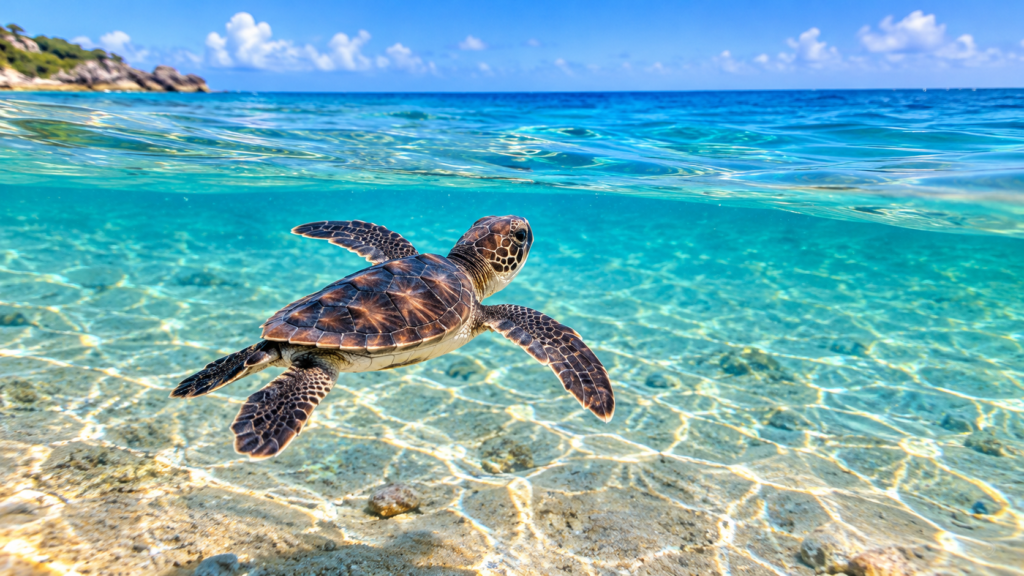
But the beach is only the beginning. Once a hatchling moves beyond the coastline, the visual world that guided it disappears. There are no familiar dunes beneath the waves and no fixed landmarks in the open sea. The turtle needs another way to maintain direction.
A Compass Hidden in the Planet
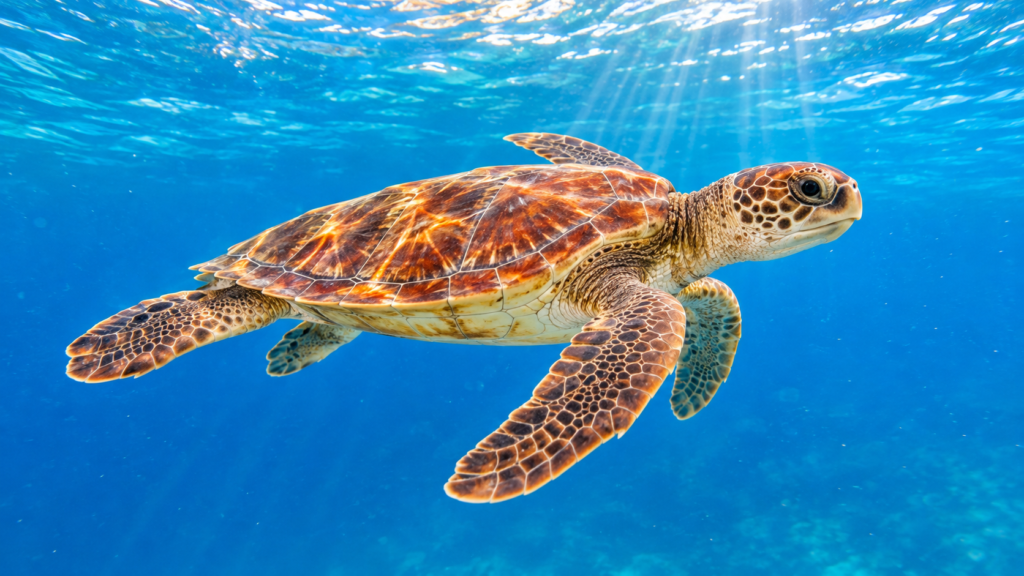
Earth behaves like a giant magnet, surrounded by a magnetic field. Humans do not normally sense this field directly, but some animals can detect it and use it for orientation. Scientists call this ability magnetoreception.
In sea turtles, magnetic information can serve at least two different purposes. A magnetic compass helps an animal maintain a direction: it can provide a sense of which way to swim. A magnetic map offers something more complicated. It can help an animal recognize where it is by detecting features of the magnetic field that vary from one geographic region to another.
Those regional signatures are not written words or visible lines. They arise partly from two properties of Earth’s magnetic field: its intensity, or strength, and its inclination, the angle at which magnetic field lines meet the Earth’s surface. The combination differs across locations, creating patterns that a turtle may learn to recognize.
Think of the compass as helping the turtle keep moving in a useful direction, while the map helps it identify a particular magnetic neighbourhood. Neither is a literal map inside the turtle’s head. It is a biological way of extracting location and direction from the planet itself.
How Scientists Tested an Invisible Sense
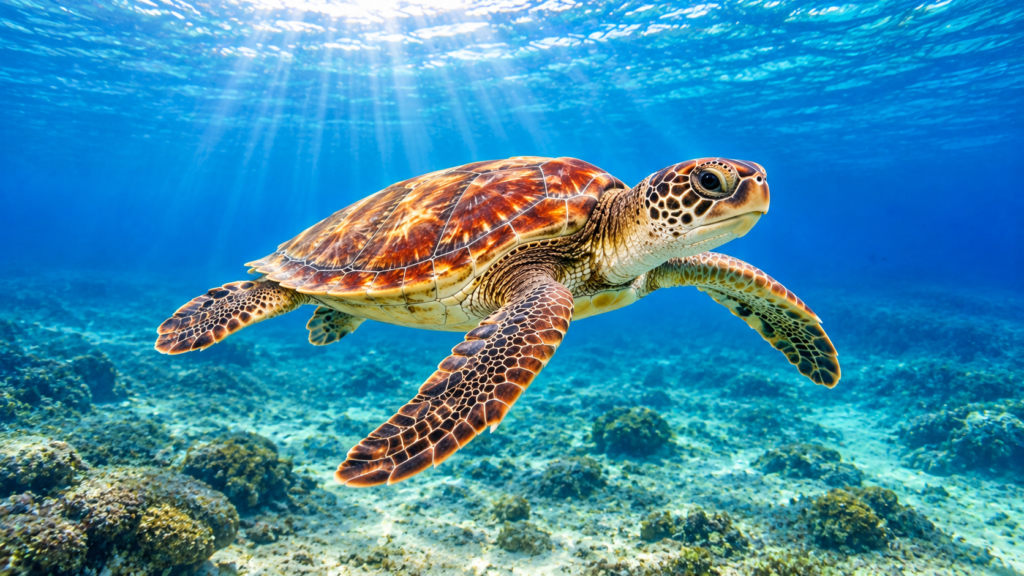
To investigate a sense that people cannot see, researchers had to create controlled versions of the magnetic environments turtles encounter in the ocean. In laboratory experiments, scientists can use electrical coils to reproduce magnetic fields associated with different geographic locations. A turtle can then be exposed to one field at a time while researchers observe its orientation or behaviour.
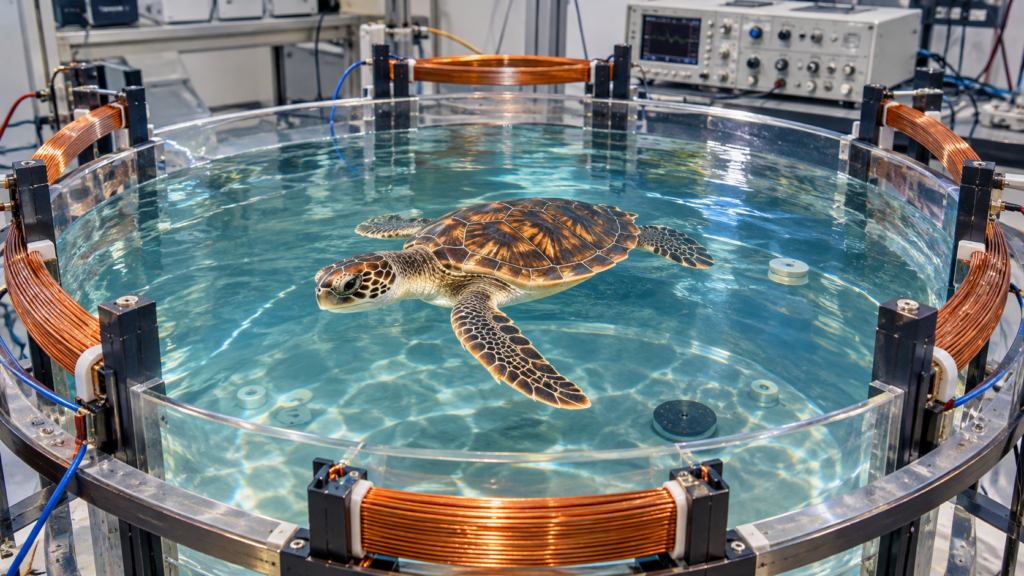
Earlier experiments showed that hatchling loggerheads respond differently to magnetic fields found at different points along their oceanic migration routes. In some regions, the turtles adopt swimming directions that could help keep them within favourable parts of the ocean. When researchers combined those observations with models of ocean currents, the results suggested that magnetic responses could help young turtles avoid being carried into less suitable waters.
This matters because a turtle does not necessarily swim every mile of its journey. Ocean currents can carry young turtles over long distances, while their own swimming helps them influence where they go. Navigation is therefore a partnership between the animal and the moving ocean—not a simple straight line across a map.
The 2025 Discovery: Turtles Can Learn Magnetic Places
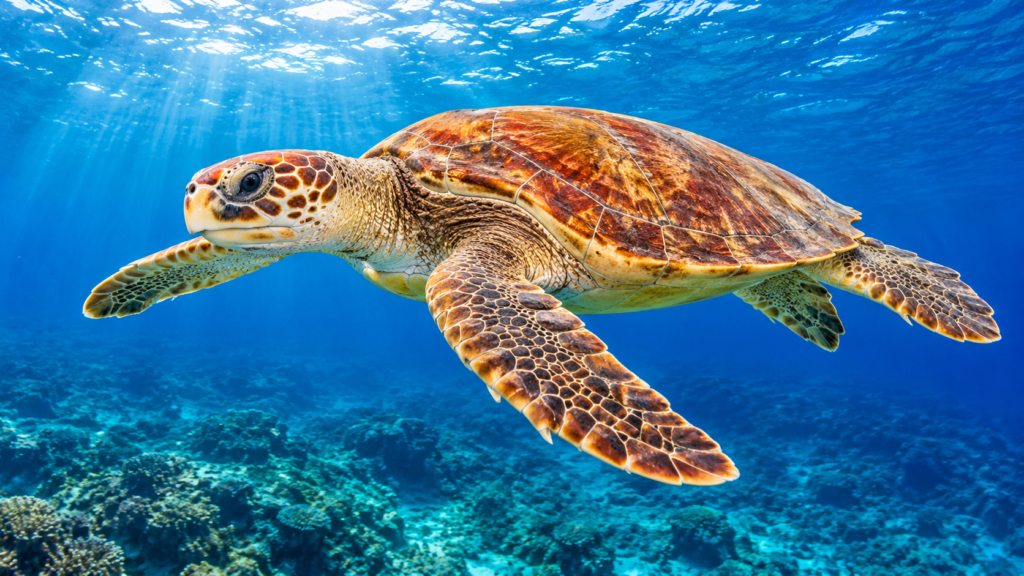
A major step forward came in a study published in Nature in February 2025. Researchers led by Kayla Goforth tested whether juvenile loggerhead turtles could learn to associate a particular magnetic field with food.
The team exposed turtles to magnetic fields designed to resemble those found in different oceanic locations. In one magnetic environment, the turtles received food repeatedly. In another, they did not. Over time, the animals learned to distinguish the field associated with feeding from the field that was not associated with food.
The result was important because it showed that turtles can learn information about magnetic locations, rather than merely reacting to a magnetic direction. The ability could help explain how they recognize productive feeding areas and show fidelity to places where they have found food before.
The study also suggested that the magnetic map and the magnetic compass may depend on different biological mechanisms. When researchers used radiofrequency fields expected to interfere with one proposed type of magnetic sensing, the turtles’ compass-related orientation was disrupted, but their learned magnetic-map responses were not. That difference points to more than one process contributing to the turtle’s magnetic sense.
A 2025 Clue: What Happens When the Magnetic Map Is Disturbed?
Another study, published in the Journal of Experimental Biology in November 2025, explored a different question: could a magnetic pulse disrupt a turtle’s ability to recognize a learned magnetic location?
Researchers tested juvenile loggerheads using a behavioural task in which the animals had learned to associate a magnetic signature with food. After exposure to a brief magnetic pulse, the turtles’ responses to the food-associated magnetic field were disrupted. The finding was consistent with the possibility that tiny particles of the mineral magnetite contribute to the magnetic-map sense.
That is an important clue, not a final answer. The experiment does not establish every detail of the receptor or prove that magnetite is the only mechanism involved. Scientists are still working to identify exactly how magnetic information is detected and transformed into behaviour.
The 2026 Breakthrough: A Clue Near the Head
In May 2026, researchers reported another advance: evidence that the receptors involved in the turtle’s magnetic-map sense may be located mostly or entirely in the head.
The team first conditioned juvenile loggerheads to recognize a magnetic field associated with food. Then they tested the turtles while placing a small, weak magnet near different parts of the body. When the magnet was attached near the head, the turtles’ learned response to the food-associated field decreased. The same effect was not observed when the magnet was placed on the middle or rear part of the shell.
The findings provide evidence pointing toward the head as a location for magnetic-map receptors. They do not identify a specific organ, cell or molecule. The researchers noted that further work is needed to narrow down the precise location and understand the mechanism. Still, the experiment gives scientists a new direction in a field where the sensory structures have been exceptionally difficult to locate.
How Does a Turtle Find Its Way Home?
The mystery becomes even more remarkable when adult females return to nest. Many sea turtles show a tendency to return to the general region where they hatched, sometimes after spending years far away. For loggerheads, the early oceanic stage can last roughly seven to fifteen years before they move into coastal feeding areas. Females may not begin nesting until decades after hatching.
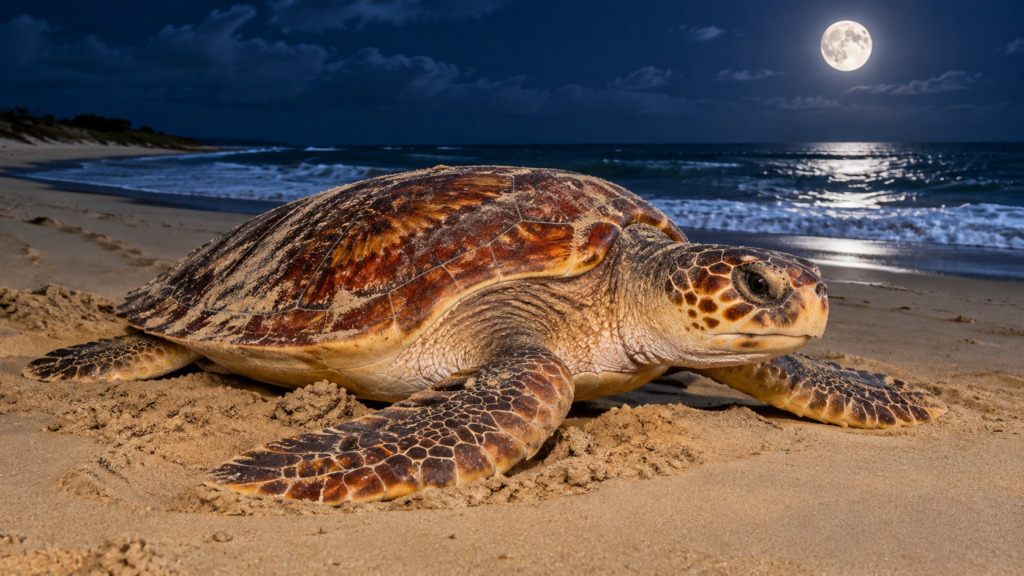
One leading explanation is called geomagnetic imprinting. The idea is that a young turtle may learn or become imprinted on the magnetic characteristics of its natal region. Later in life, those characteristics could help it recognize the broader area when it returns to reproduce.
A 2015 study examined nearly two decades of loggerhead nesting records along the Florida coast. The researchers found a relationship between the distribution of nests and subtle changes in the magnetic signatures of nearby coastal locations. Nesting was more concentrated in areas where magnetic signatures of neighbouring beach locations converged over time, and less concentrated where they diverged. The pattern supported predictions of the geomagnetic-imprinting hypothesis.
But this does not mean every turtle is guaranteed to return to one exact patch of sand, or that scientists have solved every part of natal homing. The evidence points to magnetic information as an important part of a much larger navigation system. Currents, waves, chemical cues, visual information and other environmental signals may also contribute at different stages of the journey.
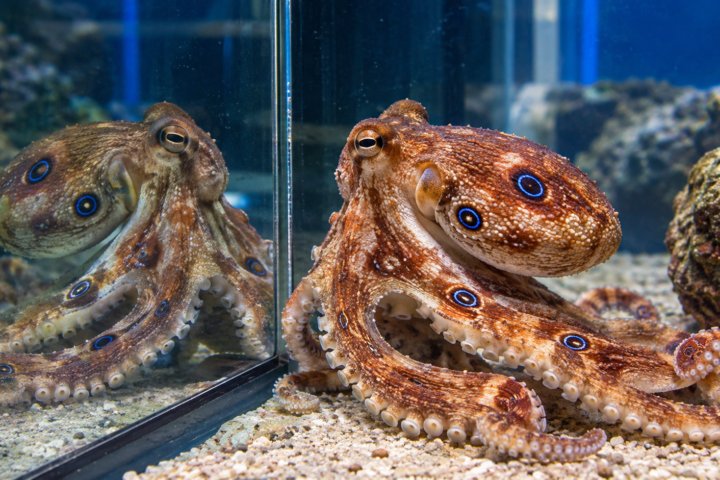
Sea turtles are not the only animals whose lives reveal surprising ways of sensing the world. Researchers have also explored how an octopus can use a mirror reflection to locate a hidden target, offering another window into the remarkable sensory abilities of marine life. Read more in our feature on the octopus that learned to use a mirror.
Long-distance movement can also depend on social and environmental information in unexpected ways. Our story about how elephants use individual, name-like calls explores another recent discovery about animal communication.
Not a Perfect GPS—and Not a Solved Mystery
It is tempting to imagine a sea turtle carrying a perfect internal GPS. The real picture is more fascinating because it is more complex. Magnetic cues are one part of navigation, not a guarantee of a precise route. The ocean is constantly moving, magnetic conditions vary, and a turtle’s journey is shaped by currents, weather, food availability and changing habitats.
Scientists also do not yet know exactly how turtles detect Earth’s magnetic field. Several mechanisms have been proposed in different animals, including processes involving magnetite or light-sensitive chemical reactions. The 2025 and 2026 studies help separate parts of the puzzle, but they have not delivered a complete explanation.
That uncertainty is not a weakness in the story. It is the reason the research is so exciting. A behaviour that once seemed almost impossible to explain can now be tested piece by piece: first by changing magnetic fields, then by teaching turtles to recognize them, and more recently by narrowing down where the relevant sensory system may be located.
The Ocean Is Changing. The Journey Is Not Getting Easier.
Even an extraordinary navigation system cannot protect sea turtles from every threat. Artificial lights can disorient hatchlings on beaches. Coastal development can reduce or disturb nesting habitat. Fishing gear can accidentally capture turtles, while plastic pollution and changes in marine ecosystems create additional risks.
Protecting nesting beaches means keeping them dark and undisturbed during the nesting and hatching seasons. In the water, reducing accidental capture in fishing gear, protecting feeding habitats and limiting pollution can all help. These actions do not depend on understanding every detail of magnetic navigation. They protect the real places turtles need to complete their life cycle.
There is also a deeper reason to protect these animals. Sea turtles connect distant parts of the ocean. A hatchling emerging on one coast may later feed in waters thousands of miles away, and an adult may cross great distances to reproduce. Their lives reveal how closely connected beaches, currents and open-ocean ecosystems really are.
A Map Written in the Planet
Return to the tiny hatchling at the water’s edge. It cannot see the coastline it will one day seek. It has no human-made map, no compass needle and no knowledge of the distances ahead. Yet the planet around it carries a pattern of magnetic information that may help guide its path.
Years later, that same animal may cross familiar magnetic signatures again, recognize a region where food was once found, or navigate toward the broad coastal area where its life began. The journey is not a flawless line, and the science is not finished. But each new experiment reveals another part of an astonishing ability.
The ocean may look like a vast, featureless blue from the surface. To a sea turtle, it may be a landscape filled with invisible directions and remembered places—a map written not in ink, but in the magnetic field of the Earth.
Scientific References
- Goforth, K. M. et al. (2025). “Learned magnetic map cues and two mechanisms of magnetoreception in turtles.” Nature, 638, 1015–1022. https://doi.org/10.1038/s41586-024-08554-y
- Mackiewicz, A. G. et al. (2025). “Disruption of the sea turtle magnetic map sense by a magnetic pulse.” Journal of Experimental Biology, 228(22), jeb251243. https://doi.org/10.1242/jeb.251243
- Lim, D. S. et al. (2026). “Evidence for cephalic magnetic map receptors in sea turtles.” Journal of Experimental Biology, 229(10), jeb252113. https://doi.org/10.1242/jeb.252113
- Brothers, J. R. & Lohmann, K. J. (2015). “Evidence for geomagnetic imprinting and magnetic navigation in the natal homing of sea turtles.” Current Biology, 25, 392–396. https://doi.org/10.1016/j.cub.2014.12.035
- NOAA Fisheries. “Loggerhead Turtle.” NOAA species profile.
- Putman, N. F. et al. (2015). “Magnetic navigation behavior and the oceanic ecology of young loggerhead sea turtles.” Journal of Experimental Biology, 218, 1044–1050. https://doi.org/10.1242/jeb.109975