

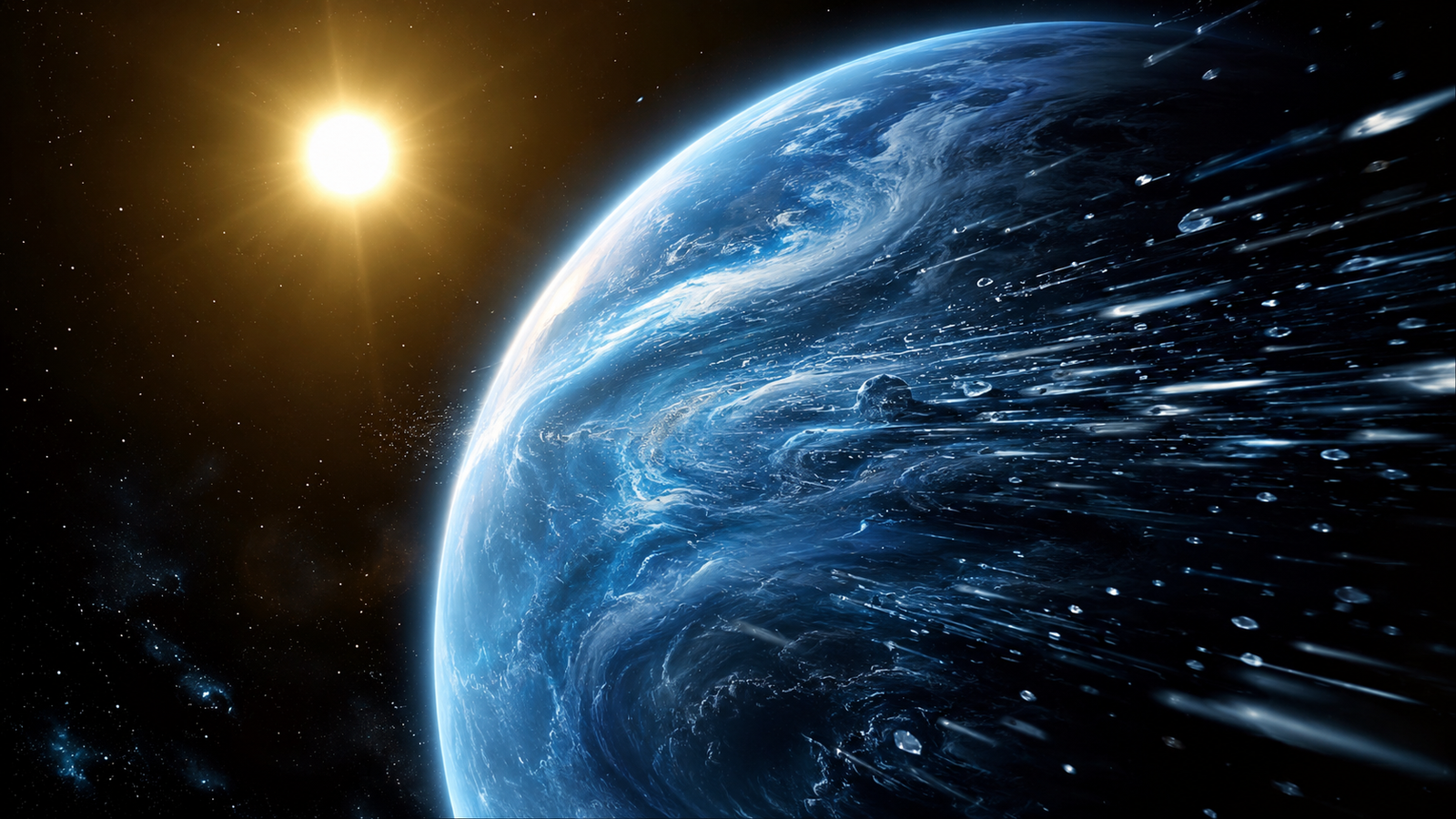
The Planet Where It Rains Glass Sideways: The Most Extreme World Ever Discovered
Imagine looking up at the sky and watching the rain begin to fall.
At first, everything seems familiar.
Dark clouds gather above you. Powerful winds roar across the horizon. The atmosphere grows colder, and the first drops finally arrive.
But these are not drops of water.
They are tiny shards of glass.
Each one is traveling faster than a jet aircraft, slicing sideways through the air at unimaginable speeds. There is nowhere to hide, nowhere to run, and no place where life—as we know it—could ever survive.
It sounds like something invented for a science fiction movie.
Yet this world is real.
More than sixty light-years away from Earth, orbiting a distant star in the constellation Vulpecula, lies a planet that has challenged everything scientists thought they knew about weather.
Its name is HD 189733 b.
And it may be one of the most terrifying places ever discovered in the universe.
For centuries, humanity believed the planets of our Solar System represented the standard design of worlds across the galaxy.
Rocky planets. Gas giants. Frozen ice worlds.
It seemed logical that most planets would resemble at least one of them.
Then astronomers began discovering planets orbiting distant stars.
One after another, these alien worlds shattered every expectation.
Some orbit so close to their stars that a single year lasts only a few Earth days. Others are darker than coal, reflecting almost no light at all. Some may even rain molten iron.
But among all these extraordinary discoveries, one planet continues to capture the imagination of scientists and space enthusiasts alike.
Not because it is the hottest. Not because it is the largest. But because its weather is unlike anything ever witnessed.
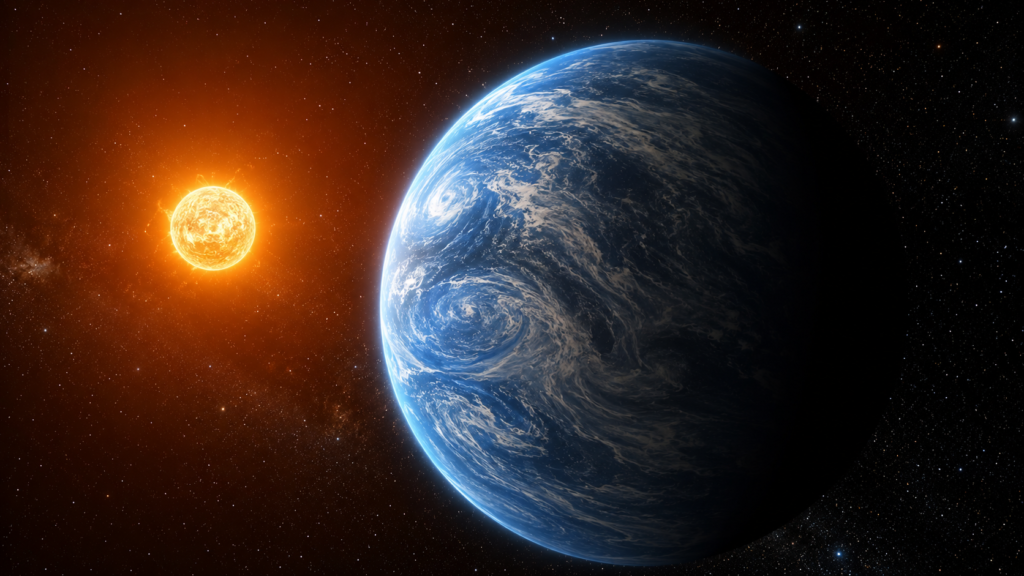
HD 189733 b is classified as a hot Jupiter—a giant gas planet roughly the size of Jupiter but orbiting incredibly close to its parent star.
If Earth were moved to the same distance from the Sun, our oceans would disappear almost instantly, our atmosphere would collapse, and the surface would become an inferno.
On HD 189733 b, temperatures climb to around 1,000°C (1,832°F), hot enough to melt many metals found on Earth.
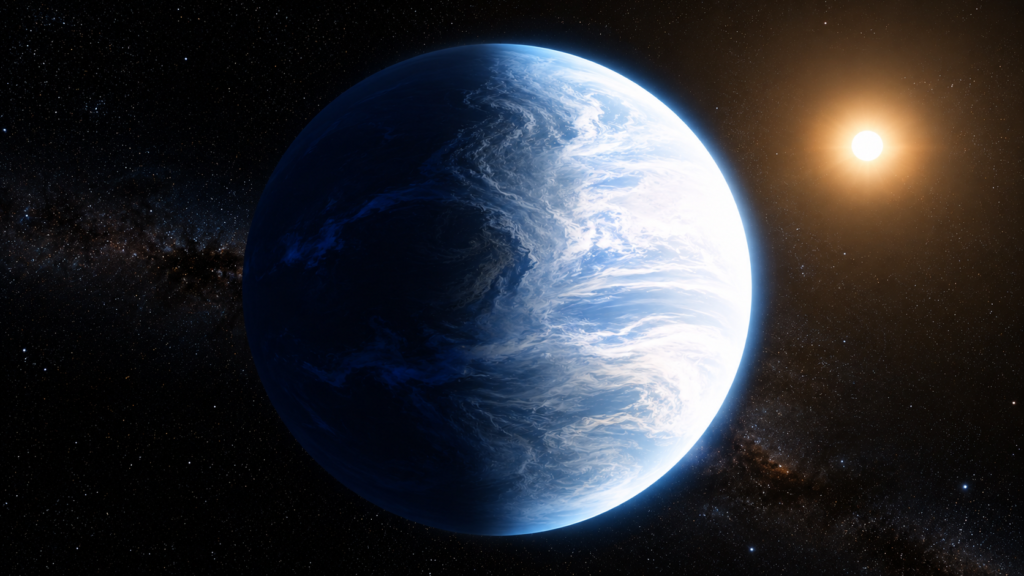
The planet is also tidally locked, meaning one side permanently faces its star while the opposite side remains in eternal darkness.
This creates one of the most violent climates scientists have ever modeled.
The blazing daylight side constantly absorbs enormous amounts of heat. Meanwhile, the night side is significantly cooler.
Nature always seeks balance. And on this planet, balance comes in the form of unimaginable winds.
Scientists estimate that atmospheric currents race across the planet at speeds exceeding 8,700 kilometers per hour (5,400 miles per hour).
For comparison, the strongest hurricanes ever recorded on Earth rarely exceed 300 kilometers per hour.
These alien winds move faster than the speed of sound. Nothing on Earth comes close.
Yet the winds themselves are only part of the story. The real mystery lies hidden within the clouds.
From hundreds of trillions of kilometers away, astronomers used powerful space telescopes to analyze the light passing through the planet’s atmosphere.
Every chemical element leaves a unique fingerprint in light.
What they discovered was astonishing.
The atmosphere contains enormous amounts of silicate particles—the same basic material used to produce glass on Earth.
Under the crushing temperatures and pressures of this alien atmosphere, these particles condense into tiny fragments.
Then the supersonic winds take over.
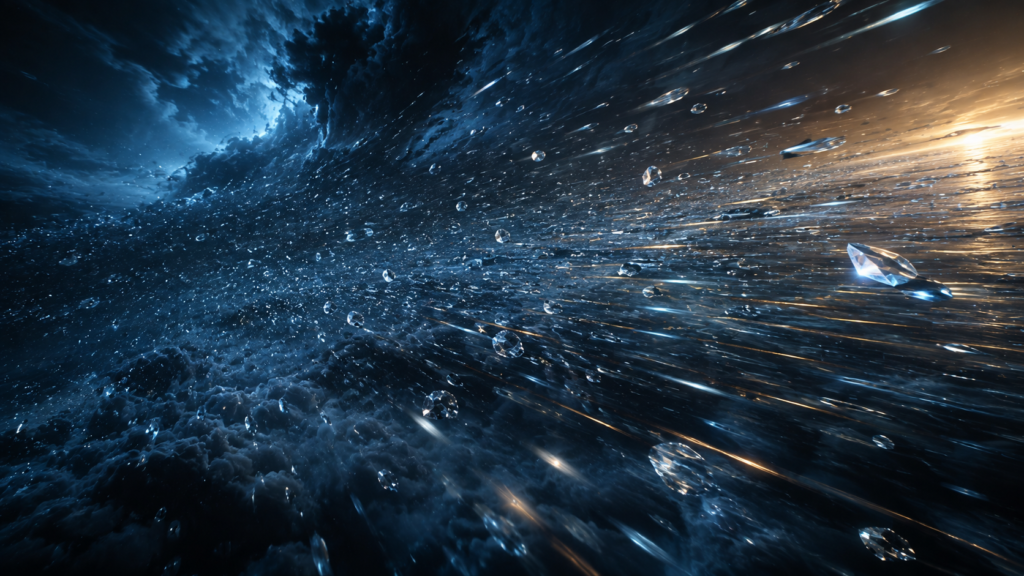
Instead of falling gently toward the ground like rain on Earth, these microscopic glass particles are blasted sideways across the planet at thousands of kilometers per hour.
Imagine standing inside a sandstorm. Now replace every grain of sand with razor-sharp glass. Multiply the wind speed dozens of times.
That is the closest comparison scientists can make. And even that barely captures the true violence of this extraordinary world.
No spacecraft has ever landed on HD 189733 b.
In fact, landing would be impossible.
Unlike Earth, the planet has no solid surface waiting beneath its clouds. It is a gas giant, meaning that as you descended, the atmosphere would simply become denser and hotter until the pressure crushed any known spacecraft long before reaching its deeper layers.
If an explorer somehow survived the journey through the upper atmosphere, the experience would be unlike anything imaginable.
The sky would glow with an intense sapphire-blue color—not because of oceans or clean air, but because microscopic silicate particles scatter blue light in the atmosphere.
Ironically, one of the most beautiful planets ever observed may also be one of the deadliest.
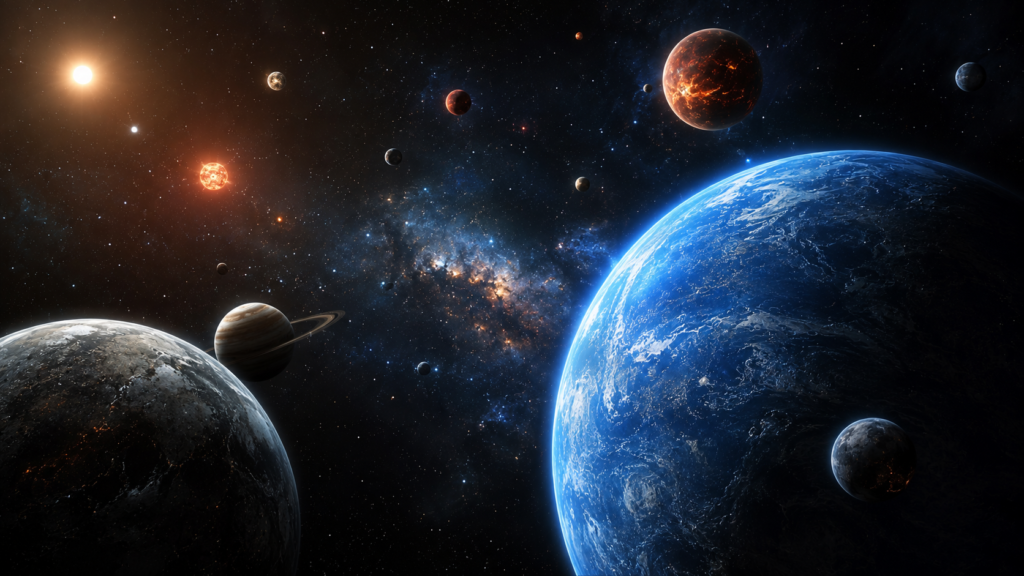
From space, HD 189733 b almost looks peaceful. Its rich blue color has often led people to compare it to Earth.
But appearances can be dangerously deceptive.
There are no oceans. No continents. No mountains. No forests. Only endless storms raging across an ocean of scorching gas.
Scientists first discovered the planet in 2005, but its true fame came years later when astronomers studying its atmosphere noticed something extraordinary.
The planet’s chemical signature revealed the presence of silicates.
Computer models suggested that under such extreme conditions, these particles would behave very differently from anything on Earth.
Instead of forming rocks or sand, they would become part of an alien weather system unlike any ever observed.
This wasn’t ordinary rain. It was a storm of microscopic glass carried sideways by supersonic winds.
The discovery immediately captured the public’s imagination.
News headlines around the world described it as “the planet where it rains glass.”
Although the phrase sounds dramatic, it reflects a real scientific interpretation of the atmospheric conditions detected by astronomers.
HD 189733 b also reminds scientists of something even more fascinating. Our imagination is often too limited.
For thousands of years, humanity believed weather meant rain, snow, hail, fog, or wind.
But once we began discovering planets beyond our Solar System, we realized that weather can take forms we never imagined.
Some worlds may rain molten iron. Others could have clouds made of gemstones or minerals. Some planets are so hot that metals exist as vapor high in the atmosphere before condensing into liquid droplets.
The universe continuously proves that nature is far more creative than fiction.
Every new exoplanet discovered forces scientists to rethink the limits of planetary science.
It also raises one of the biggest questions in astronomy.
If planets this extreme exist, how many other unimaginable worlds are still waiting to be found?
Today, astronomers have confirmed thousands of exoplanets, and each year brings hundreds of new discoveries.
Some may resemble Earth. Some could potentially support life. Others, like HD 189733 b, remind us that not every planet is a place where life could ever flourish.
Instead, they reveal the incredible diversity of our galaxy.
Each discovery adds another piece to a puzzle that humanity has only just begun to solve.
Somewhere beyond the reach of our most powerful telescopes, countless unseen planets continue orbiting distant stars.
Among them may be worlds stranger than anything we have imagined so far.
And perhaps, one day, another discovery will make a planet of sideways glass rain seem almost ordinary.
Frequently Asked Questions
What is HD 189733 b? HD 189733 b is a gas giant exoplanet located about 64 light-years from Earth in the constellation Vulpecula. It is one of the most studied exoplanets because of its extreme atmosphere and unusual weather conditions.
Does it really rain glass on HD 189733 b? Current scientific observations strongly suggest that the planet’s atmosphere contains silicate particles that can condense into tiny glass-like fragments. Powerful winds are believed to drive these particles sideways at tremendous speeds, which is why it is often described as a planet where it “rains glass.”
Why is the rain sideways? The planet experiences extreme atmospheric winds that can exceed 8,700 km/h (5,400 mph). These winds are so powerful that they carry the glass particles horizontally instead of allowing them to fall straight down.
Could humans ever visit this planet? With today’s technology, no. HD 189733 b is far beyond our reach, and its extreme temperatures, crushing pressure, and violent storms would make human survival impossible.
Why do scientists study planets like this? Extreme planets help scientists understand how planetary atmospheres work under conditions completely different from those in our Solar System. Every discovery improves our understanding of how planets form, evolve, and interact with their stars.
Final Thoughts
The universe has a remarkable way of reminding us how small our imagination really is.
A century ago, people believed every planet would be similar to the worlds orbiting our Sun.
Today, we know better.
We have found planets darker than charcoal, worlds hotter than molten lava, and giant gas spheres where winds travel faster than sound.
Among them, HD 189733 b stands out as one of the most unforgettable—a breathtaking blue world where razor-sharp glass storms race across the sky at unimaginable speeds.
It is beautiful. It is terrifying. And it is real.
Every new telescope peers a little farther into the darkness, revealing worlds that rewrite everything we thought we knew about the cosmos.
Perhaps the greatest discovery is not that a planet like this exists.
It is that somewhere in the endless ocean of stars, there are almost certainly worlds even stranger, waiting patiently for humanity to find them.
Discover More on The Oddnova
If you enjoyed exploring one of the most extreme planets ever discovered, don’t stop here.
The universe is filled with impossible worlds, mysterious cosmic phenomena, and breathtaking discoveries that continue to challenge everything we know about space.
Stay curious—because the next incredible discovery may already be waiting among the stars.
Read Also →
📖 50 Amazing Facts About Space and the Universe
📖 Top 10 Ancient Mysteries That Still Baffle Scientists Today
📖 7 Unexplained Mysteries That Continue to Puzzle Experts Today