

35 Deep Sea Creatures That Look Like Alien Monsters
The ocean covers more than seventy percent of our planet, yet we have explored less of it than we have explored the surface of Mars. Somewhere beneath the sunlight, past the point where the water turns black and the pressure could crush a car like a soda can, an entire universe of creatures lives out its existence in total darkness. These are not monsters from science fiction. They are real, they are alive right now, and some of them have barely changed in over a hundred million years. Grab a flashlight, because we are about to descend into the deep.
Welcome to the Twilight Zone
The journey begins around 200 meters below the surface, in a region scientists call the Twilight Zone. Sunlight is fading fast here, and the creatures that live in this dim blue world have had to get creative to survive.
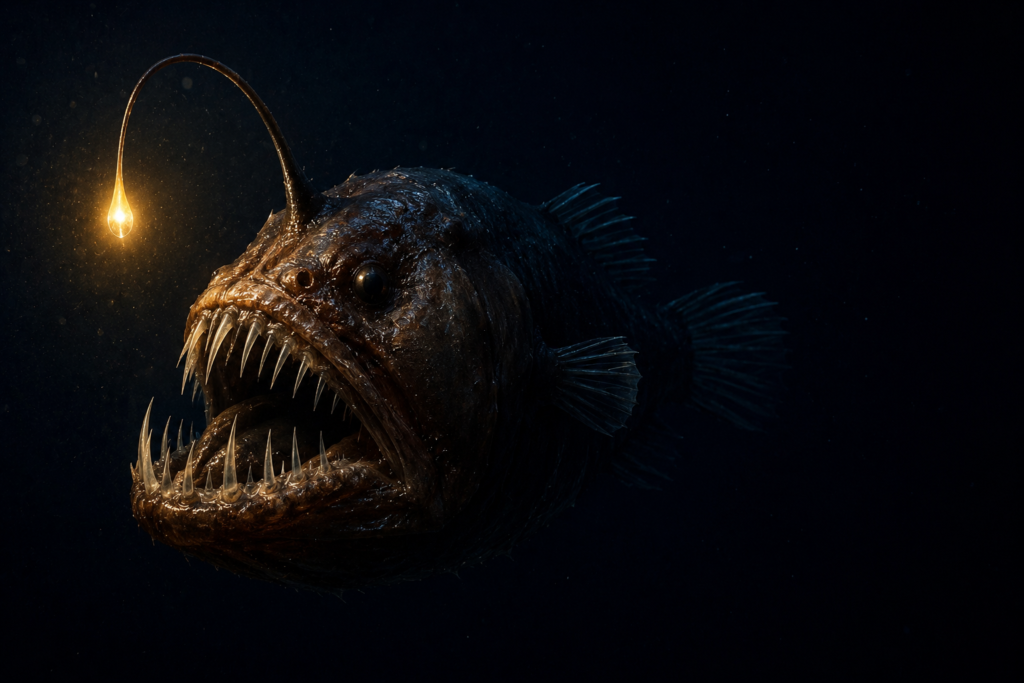
The anglerfish is the celebrity of this neighborhood, and for good reason. A glowing lure dangles from its forehead like a tiny lantern, swaying gently to lure curious prey close enough to vanish into a mouth full of needle-thin teeth. What most people do not know is that the tiny males of this species are almost parasitic, fusing permanently onto the much larger females and living the rest of their lives as little more than a sperm-producing appendage.
Nearby drifts the hatchetfish, a creature so flat and silver it looks like it was cut from tin foil. Its upward-facing eyes and light-producing belly work together in a trick called counter-illumination, canceling out its shadow so predators looking up from below simply cannot see it against the faint light above.
Then there is the fangtooth, arguably the fish with the most disproportionate teeth on Earth relative to its body size. Its fangs are so long that its skull actually has special sockets so it can close its mouth without stabbing its own brain.
Into the Midnight Zone
Descend past 1,000 meters and the light disappears completely. This is the Midnight Zone, and everything here has adapted to a life without a single photon of natural sunlight ever reaching it.
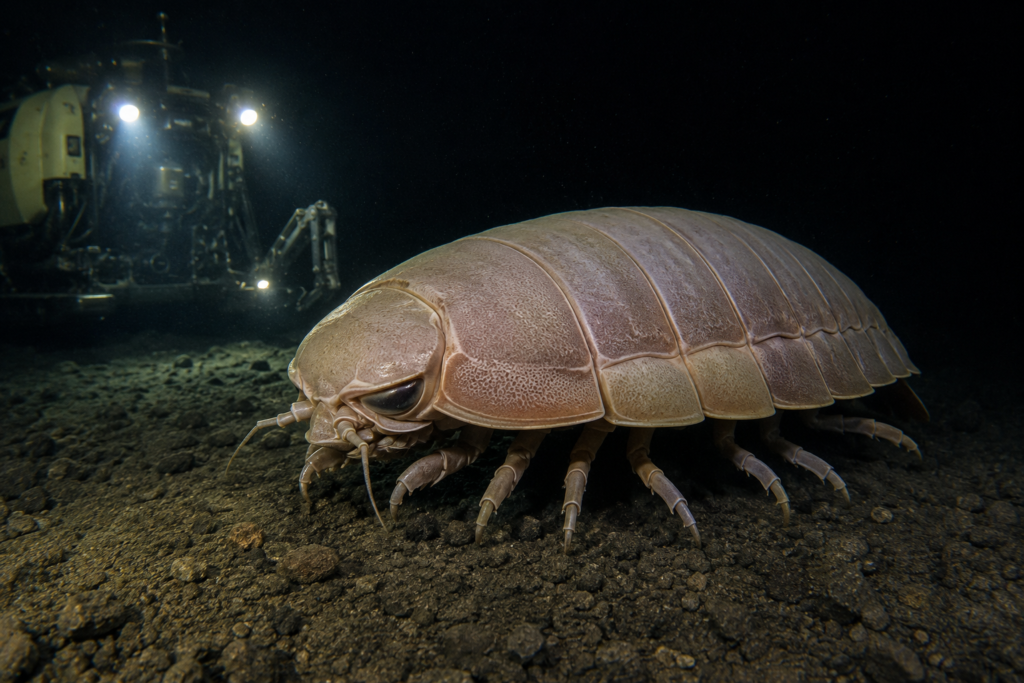
The giant isopod looks like something that crawled straight out of a nightmare, and in a way, it did. This armored crustacean can grow larger than a house cat, and it survives by scavenging whale carcasses on the seafloor and going months, sometimes years, without eating again. Scientists have documented giant isopods surviving over five years without a single meal.
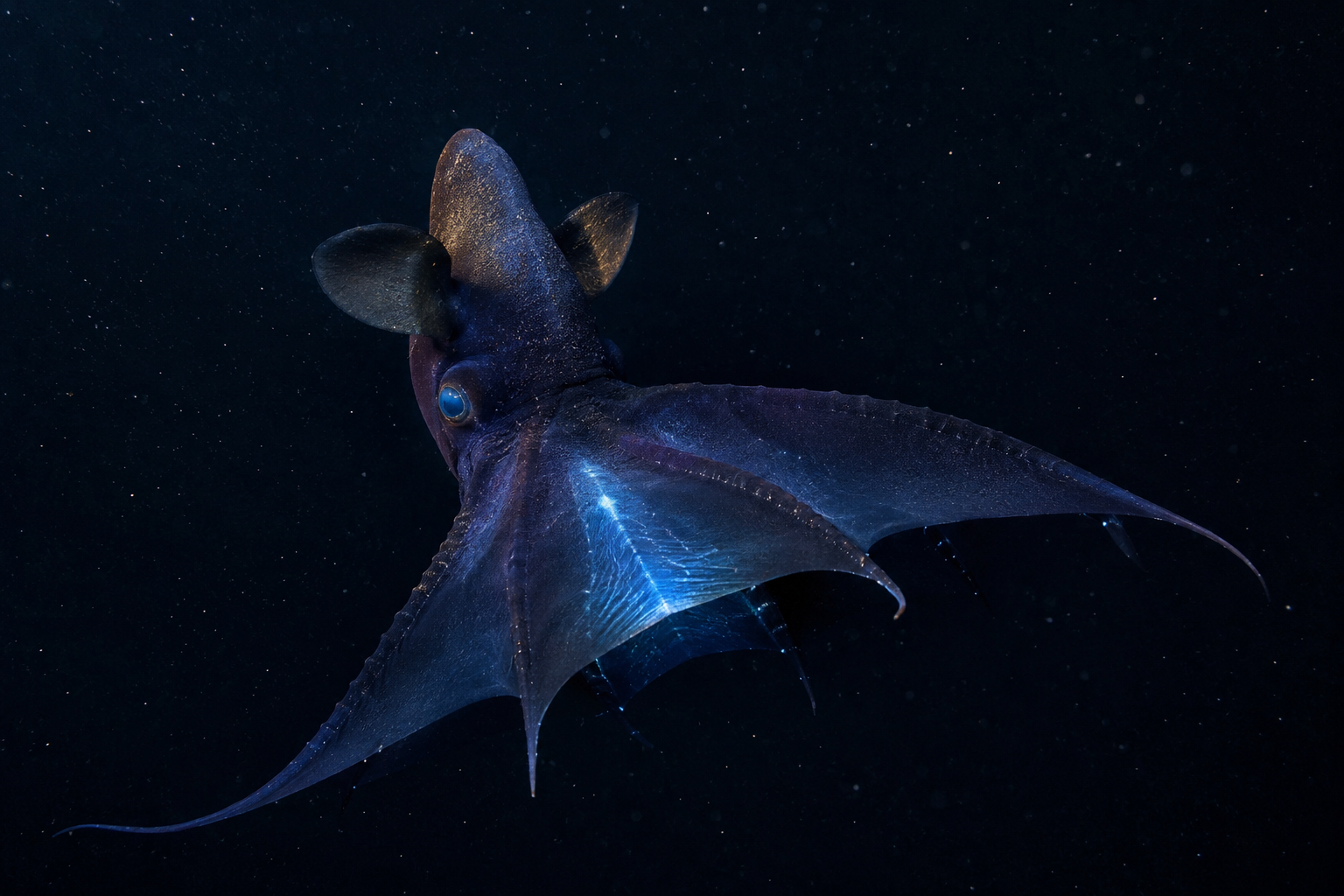
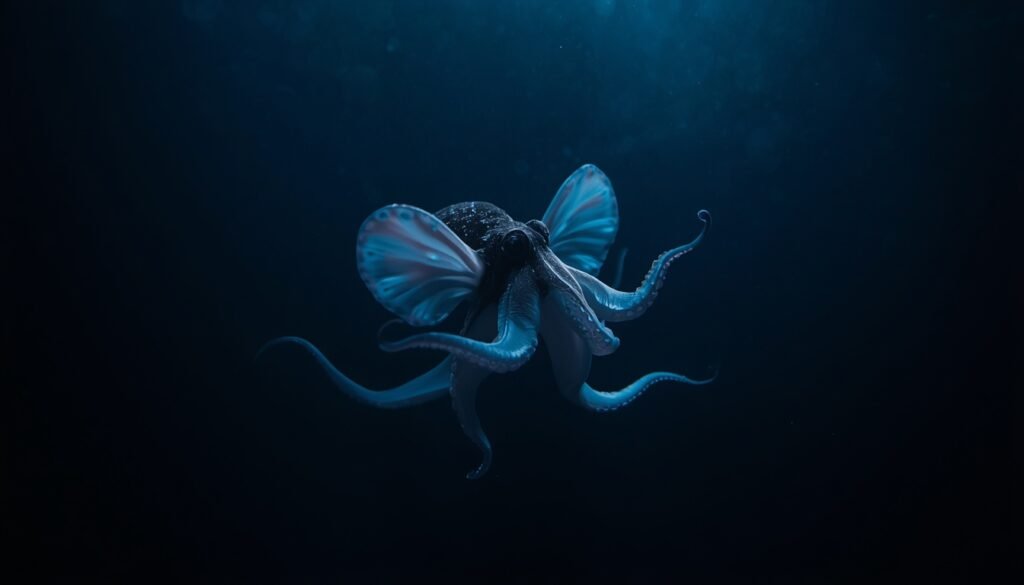
Floating just above the mud is the dumbo octopus, named after the Disney elephant because of the two fin-like flaps on its head that make it look like it is perpetually flying through the water. Unlike its more aggressive octopus cousins, the dumbo octopus swallows its prey whole and drifts through the darkness with an almost peaceful, balletic grace.
The vampire squid earns its dramatic name from its dark, cloak-like webbing between its arms, which it can pull over its body like a cape when threatened. Despite the terrifying branding, it does not hunt at all. It gently filters marine snow, the slow drift of organic debris falling from above, making it one of the gentlest giants of the abyss.
And then there is the fangtooth’s neighbor, the stoplight loosejaw, a fish that has evolved the extraordinary ability to produce red bioluminescent light, a wavelength almost no other deep sea creature can see. It uses this secret red flashlight to hunt prey that has no idea it is even being watched.
The Abyssal Zone: Where the Pressure Could Crush You
Beyond 4,000 meters lies the Abyssal Zone, a place with pressure so extreme that a human body descending unprotected would be crushed almost instantly. Yet life not only survives here, it thrives in genuinely bizarre ways.
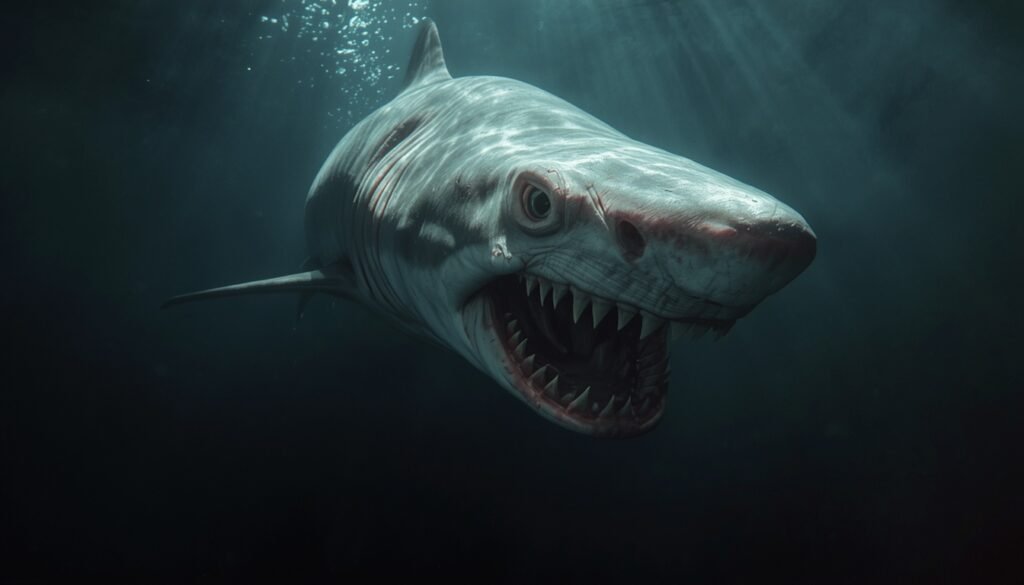
The goblin shark looks like a creature assembled from spare parts of different animals: a long flat snout like a blade, pale pink translucent skin, and a jaw that can shoot forward out of its mouth in a fraction of a second to snatch prey, then snap back like something out of a horror film. Fossil evidence suggests this shark family has looked essentially the same for over 125 million years, making it a genuine living fossil swimming through our modern oceans.
The gulper eel, sometimes called the pelican eel, has a mouth so enormous relative to its body that it looks physically impossible. This adaptation allows it to swallow prey far larger than itself in a single gulp, an essential skill in a part of the ocean where meals are rare and opportunities cannot be wasted.
Drifting silently nearby is the sea pig, a soft pink sea cucumber that walks along the seafloor on stubby tube-like legs, vacuuming up sediment in search of nutrients. Thousands of them can gather in a single spot, turning the pitch-black seafloor into something that looks almost like a strange alien pasture.
The Hadal Zone: The Final Frontier
At the very bottom, in trenches deeper than Mount Everest is tall, lies the Hadal Zone. Named after Hades, the Greek god of the underworld, this is the most extreme and least explored habitat on the entire planet.
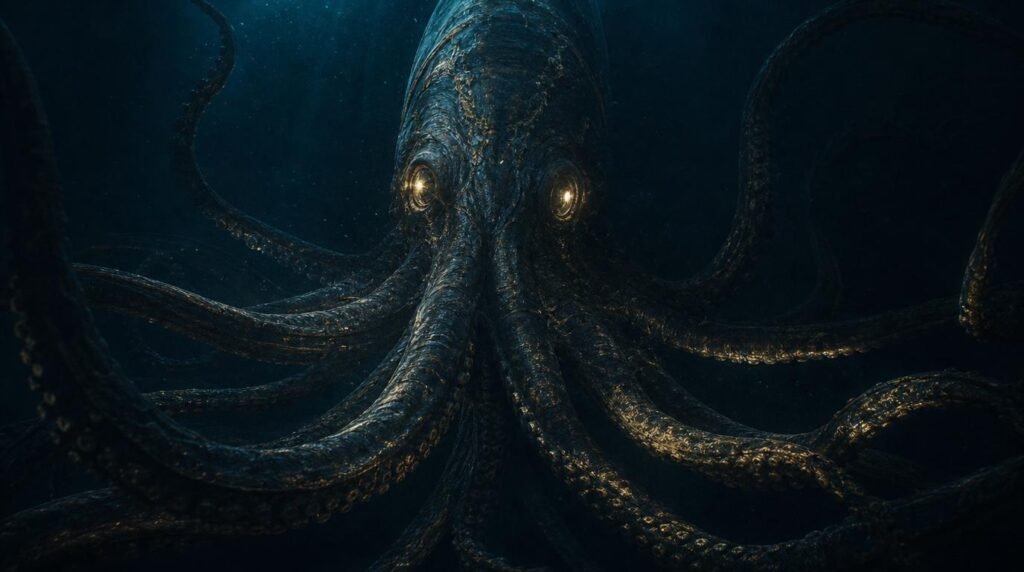
Here lives the colossal squid, a creature so elusive that scientists have only ever studied a handful of complete specimens. With eyes the size of dinner plates, the largest of any animal on Earth, it is built to detect the faintest flicker of bioluminescent light in a world of absolute darkness. Its swiveling hooks, lined along its tentacles, can rotate independently to lock onto prey with terrifying precision.
Sharing this crushing darkness is the Mariana snailfish, currently the deepest-living fish ever recorded, found thriving at depths beyond 8,000 meters. Its body is soft, almost translucent, and completely lacking the swim bladder most fish rely on, an organ that would be instantly crushed at that depth anyway.
Why These Creatures Matter
It is tempting to look at these animals and simply feel a chill down your spine, but there is something genuinely humbling about them too. Every single one of these thirty-five creatures has spent millions of years perfecting a life in conditions that would be instantly fatal to almost anything else on Earth, including us. No sunlight. Crushing pressure. Near-freezing temperatures. And yet, life did not just survive there. It flourished, adapted, and evolved into some of the most visually stunning and biologically fascinating organisms our planet has ever produced.
The deep ocean is often compared to outer space, and it is not just a poetic exaggeration. We have mapped more of the surface of the Moon than we have of our own ocean floor. Every submersible dive into these depths still has a real chance of discovering a species no human has ever laid eyes on. In a very real sense, the aliens we have been searching for in the sky may have been quietly living in our own backyard the entire time, just a few thousand meters beneath the waves.
So the next time you look out at the ocean and see nothing but calm blue water stretching to the horizon, remember what is happening just beneath the surface, in a world with no light, no silence, and no rules except one: adapt, or disappear into the dark forever.
Read Also:
📖 50 Amazing Facts About the Human Body You Never Knew
📖 50 Amazing Facts About Space and the Universe
📖 Top 10 Ancient Mysteries That Still Baffle Scientists Today
📖 7 Unexplained Mysteries That Continue to Puzzle Experts Today